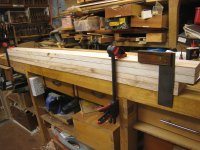
It seems that nearly three weeks have passed since my last update and some of you might be wondering if I have just been staying in the bed we already have, or getting on with things at my usual glacial speed.
Well, ̶a̶ ̶b̶i̶g̶ ̶b̶o̶y̶ ̶s̶t̶o̶l̶e̶ ̶m̶y̶ ̶b̶e̶s̶t̶ ̶p̶l̶a̶n̶e̶ ̶a̶n̶d̶ ̶r̶a̶n̶ ̶a̶w̶a̶y̶ somehow other things have got in the way, and I haven't done much. And what I have done is hard to make interesting - I've been deciding which bits go where and carrying on with making them the right size. Several shortish sessions in the workshop but not much to show for them.
Although I had extracted a set of sawn pieces from the boards and marked them up, I want to be sure that the best looking ones go in the most visible positions. One of the disappointments/blessings of this design of bed is that a lot of the surfaces will be hidden by the mattress or facing the wall. Some of the wood has some irregularities in the grain which could look nice, but if I can't get them straight and smooth I shall have to hide them away.
Perhaps the most challenging is this bit:

With hindsight, I should have left this one in the rack, which is what all the previous customers had done, but stock was low and I needed a piece this size. It's reasonably thick, so I thought I could get an inch board out of it.
It will be one of the cross-rails, with the mattress hiding one face. If I can get one surface flat and straight, it could go on the visible side of the foot end. The inside surface will need to be smooth but it won't matter much if it's not straight, as it will be up against the mattress. I don't know if this is what anyone else would do, but this is how I went about it.
I put the wonky piece on top of the much better rail from the other end of the bed, which is flat and straight enough, despite what that little shadow off to the right might suggest. I then sharpened a little pencil so it would lie flat on the reference surface and scribe a line across most of the gap. (Not all of the gap; I don't want to make this too thin and a bit of concavity is ok.)

I then planed the bumps off that side, leaving some shallow dips.
Now, the normal way to mark the thickness and define the opposite face would be to use a marking gauge, but that would give me a parallel, wavy line, not a straight one.
Instead, I used a surface gauge, running along the chipboard as a reference, to scribe a straight line along both edges.


I could then plane the bumps off on the outside, going all the way to the line. It felt odd using a smoothing plane and going to what is almost a finished surface before I have cut the joints, but I need to be sure that the outside face won't have any horrible tear-out on it, before I have no choices left.
This board was a challenge to plane, with bits of rippled grain reversing suddenly. I tried several techniques, including using a jack plane diagonally and a very fine set smoother with the cap iron close.
But to get the bulk of the planing done, I found that two less common approaches helped. One was using this little ECE smoother:
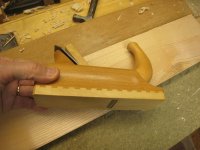
It is a smoother - not all horned planes are scrub planes - and although it's only got a single iron, the combination of a relatively short body, narrow cut and the horn made it easy to work short lengths in the direction they they needed to be planed, reversing my direction of attack rather than swivelling the wood around continually.
I also made a lot of use of a toothing plane.

These are really useful. Their virtue in veneering is apparently the ease with which they will level off any surface and I like the way that you can use one on really recalcitrant reversing grain while planing in any direction you need - round and round if you want. The only downside is that the threadlike shavings don't eject from the mouth and soon clog it up:

so I had to keep stopping and poking them out with a little scrap of wood. If anyone knows a clever trick to avoid that, please say!
Some people might think that there is no need to distract myself introducing extra tools to solve a problem like this wavy wood, but I am happy exploring and experimenting, even if it takes longer and I forget the results.

And so, after today's session I have a flat surface on this board that I think will be ok on the show side. Here's a nice bit, which is hard to photograph but I assure you feels nice and smooth:

However, further along there is a blotchy area which I am not sure about. I've removed very little wood from the original mill-planed surface at this point. I wonder if the dark spots were where damp sawdust was left on the boards in stick? I wetted the surface with some alcohol to show them up

This view is after some brief sanding with 80 grit Abranet. You can see that I have not yet touched all of the surface, but I hope the blemishes will disappear. I don't want to sand this all now and then do it again after cutting all the joints - I'd like to sand once and tidy up any marks from clamping, handling etc. So any reassurance from someone with experience is welcome!

I still have quite a bit more of this to do before I can mark out my first mortise and tenon joints on this project, but there will be more delays and interruptions before I finish. At present, cold winter days are ideal for handwork in my unheated playroom, but spring weather will bring various trips away, family events etc, so I'm not putting any dates on this yet.