• Hi all and welcome to TheWoodHaven2 brought into the 21st Century, kicking and screaming! We all have Alasdair to thank for the vast bulk of the heavy lifting to get us here, no more so than me because he's taken away a huge burden of responsibility from my shoulders and brought us to this new shiny home, with all your previous content (hopefully) still intact! Please peruse and feed back. There is still plenty to do, like changing the colour scheme, adding the banner graphic, tweaking the odd setting here and there so I have added a new thread in the 'Technical Issues, Bugs and Feature Requests' forum for you to add any issues you find, any missing settings or just anything you'd like to see added/removed from the feature set that Xenforo offers. We will get to everything over the coming weeks so please be patient, but add anything at all to the thread I mention above and we promise to get to them over the next few days/weeks/months. In the meantime, please enjoy!

Dr Al's Latest Folly

I forgot to say that you have made a nice bowl there. Will you keep the base like that?. I have come to prefer a ring foot, ie a a raised foot say 1mm wide. I find it is less likely to rock on an uneven surface.
Like this
IMG_3067.jpeg
 
Woodbloke":2lntdp04 said:
What happens when somebody (the missus?) places a hypothetical order for a dining table to seat six+? :lol: - Rob

I'm very fortunate in that my other half very rarely asks for specific stuff - she's sees the workshop as my hobby and is happy for me to do whatever takes my fancy. She also has a sense of realism, so would be well aware that a large dining table isn't a realistic project in my workshop :D

Andyp":2lntdp04 said:
I forgot to say that you have made a nice bowl there. Will you keep the base like that?. I have come to prefer a ring foot, ie a a raised foot say 1mm wide. I find it is less likely to rock on an uneven surface.
Like this
On the first Sycamore box, I mounted the box with the button jaws and turned the base away. On the second one I've left it as-is, but it only contacts around the rim: the central bit is very slightly inverse-conical. I really like the look of your "ring foot" - that's really neat. Not that I'm going to make any more bowls... apart from the one I made today...
 
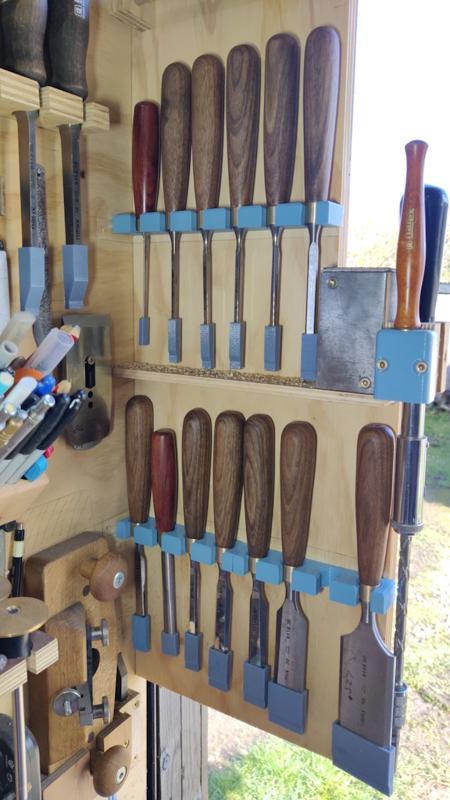
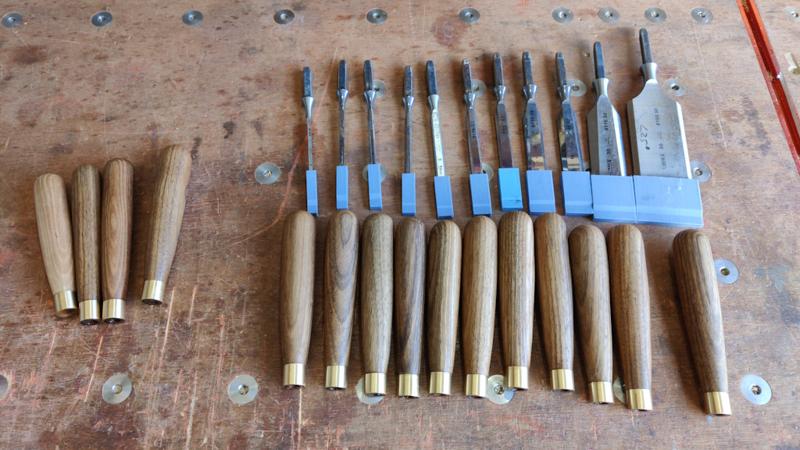
The first job this morning was to finish off the chisel handles. They've had two coats of Mike's Magic Mix and I decided that was enough for now. I can always add more coats later if necessary. I took the old handles off the chisels and lined them up with their new handles:

chisel_handles_ready_for_fitting_800.jpg


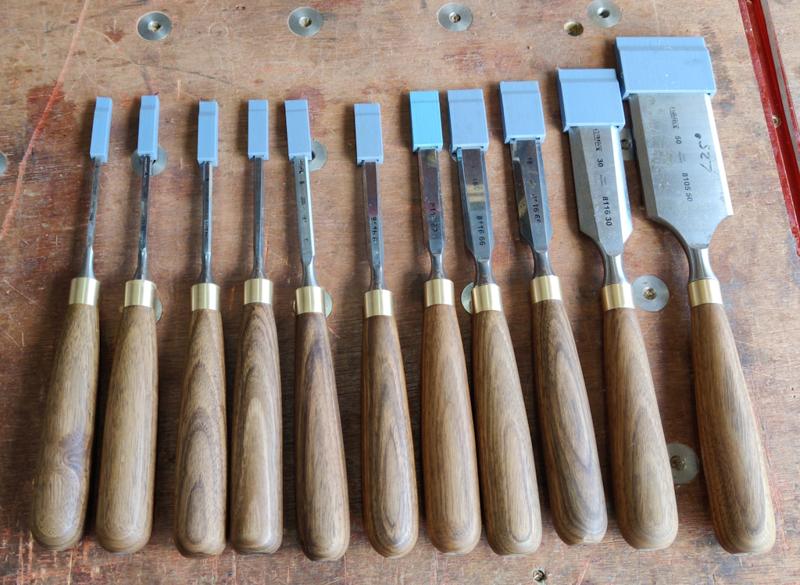
Then it was just a case of fitting them:

chisels_fitted_to_handles_800.jpg


The new ferrules are a different diameter to the old ones, so I also had to make a new storage rack, but the 3D printer did most of the work there.

chisel_rack_800.jpg


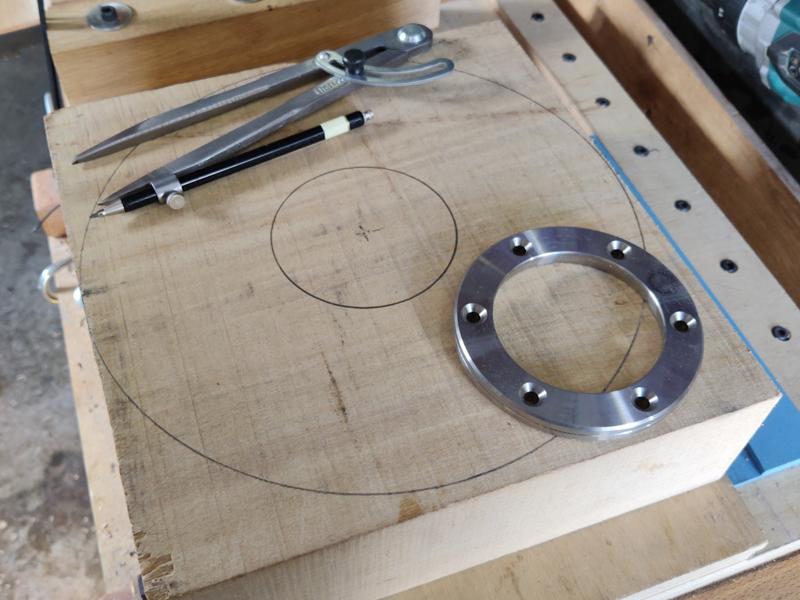
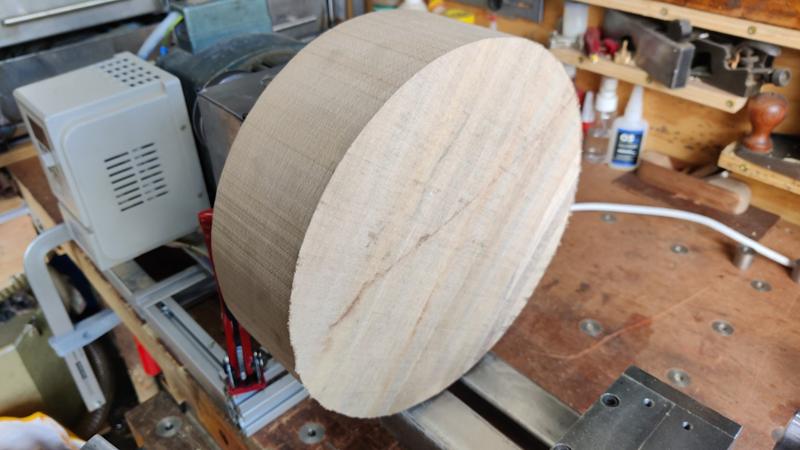
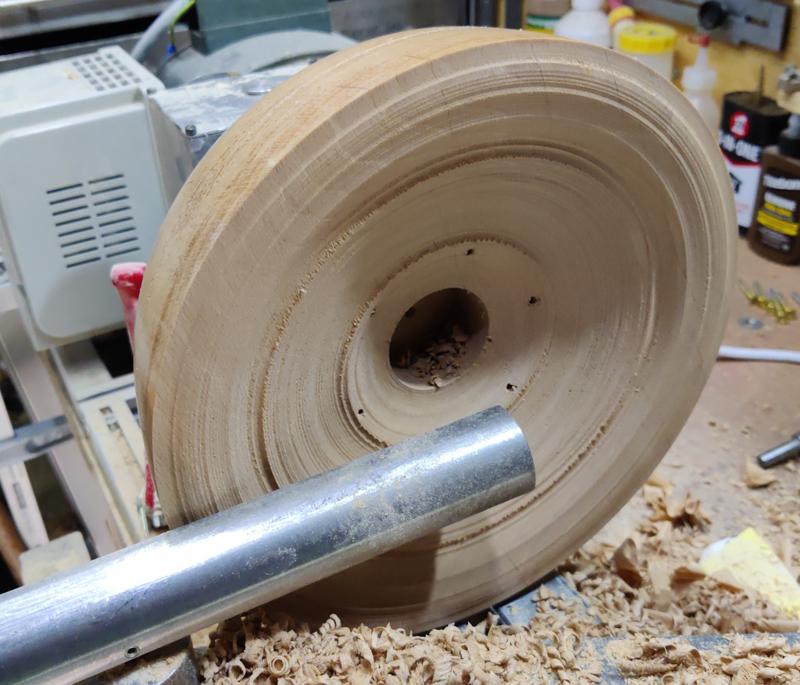
I said only yesterday that I couldn't see me making many more bowls. That's still true, but I wanted to "test the envelope" of the lathe, so I decided to have a go at making a much larger bowl. I started by sawing the end off a large (260 mm wide and 75 mm thick) piece of beech that I had ferreted away. I then drew a couple of circles on the face, one 250 mm diameter and one 84 mm diameter (the latter was chosen to match the faceplate thing I'm going to use to mount it):

beech_with_circles_800.jpg


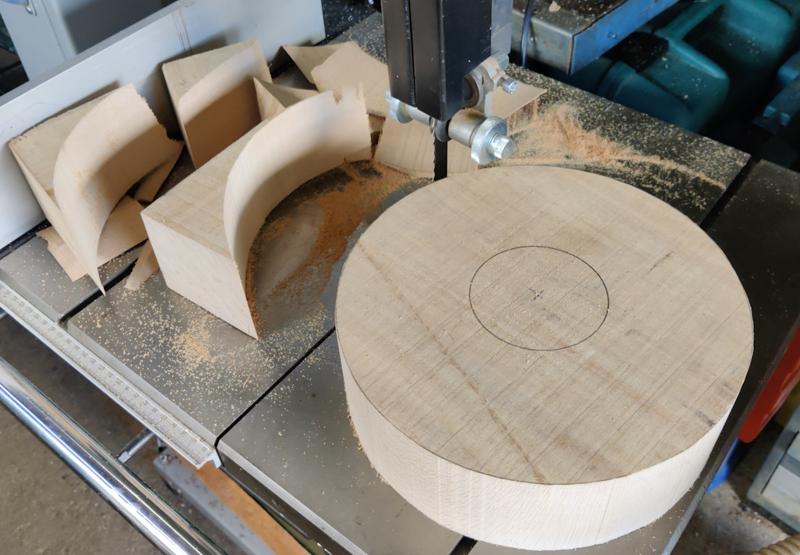
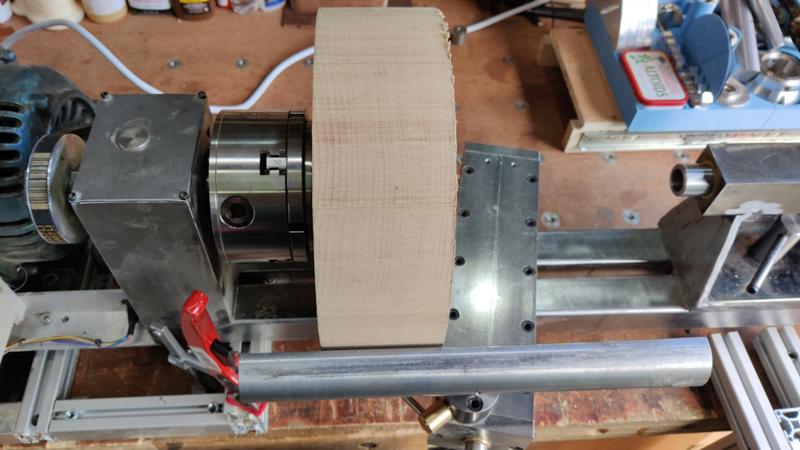
The bandsaw then got used to cut as close as possible to the outside circle. The centre height of the lathe is about 128 mm, so the absolute maximum diameter workpiece would be 256 mm. With a 250 mm blank, it has to be very close to circular before I mount it on the lathe or the corners will hit the bed.

beech_bandsawed_800.jpg


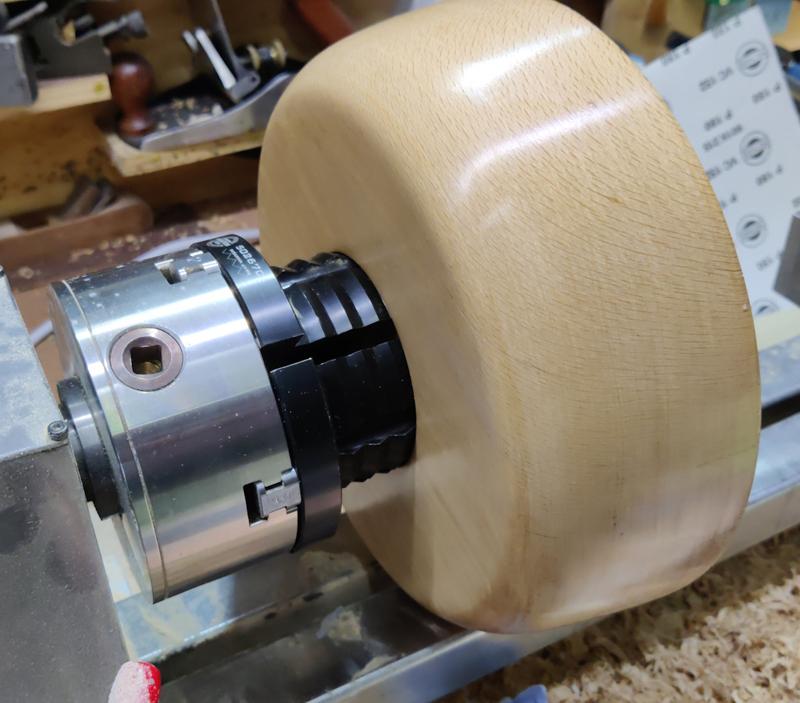
After drilling some pilot holes in the face, I screwed the faceplate to the beech blank with some 5 mm × 50 mm wood screws and mounted it in the chuck jaws:

beech_mounted_1_800.jpg


There's a couple of millimetres of clearance under the blank, but that's it:

beech_mounted_2_800.jpg


Turning the outside proceeded relatively smoothly. The (1.1 kW) motor has loads of power so there were no issues there. I still had a few catches with the bowl gouge and I ended up doing quite a lot of scraping (and then loads of sanding) to clean it up, but it came out okay all things considered:

beech_outside_turned_and_sanded_800.jpg


After a coat of sanding sealer and some beeswax...

beech_outside_waxed_800.jpg


...it was time to turn it round and mount it using the dovetailed pocket I'd turned in the base:

beech_reversed_chuck_jaws_800.jpg


To make hollowing a bit easier, I started by putting a 45 mm Forstner bit in the drill chuck and plunging it in. I then used the bowl gouge to cover myself and everything else in beech shavings. In progress:

beech_starting_hollowing_800.jpg


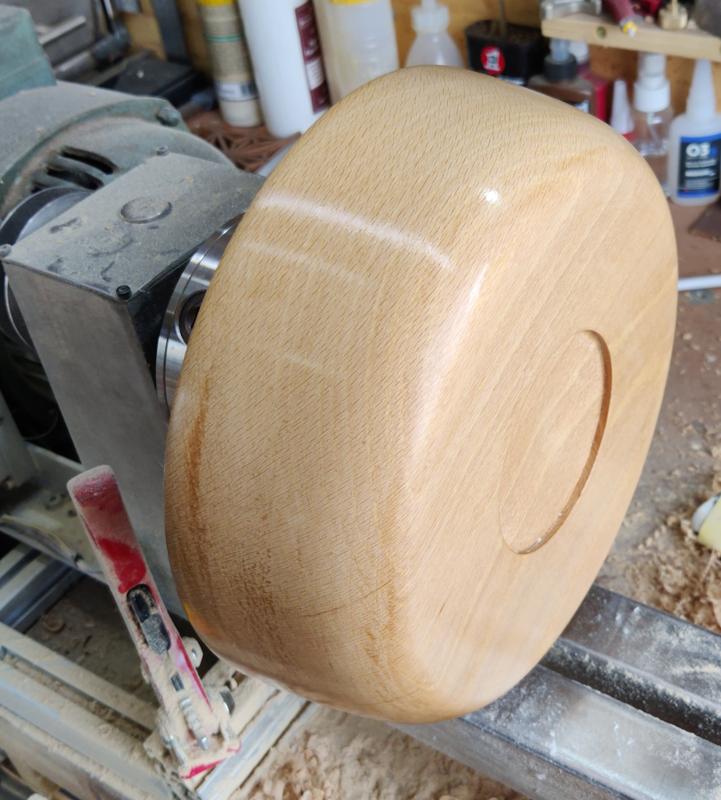
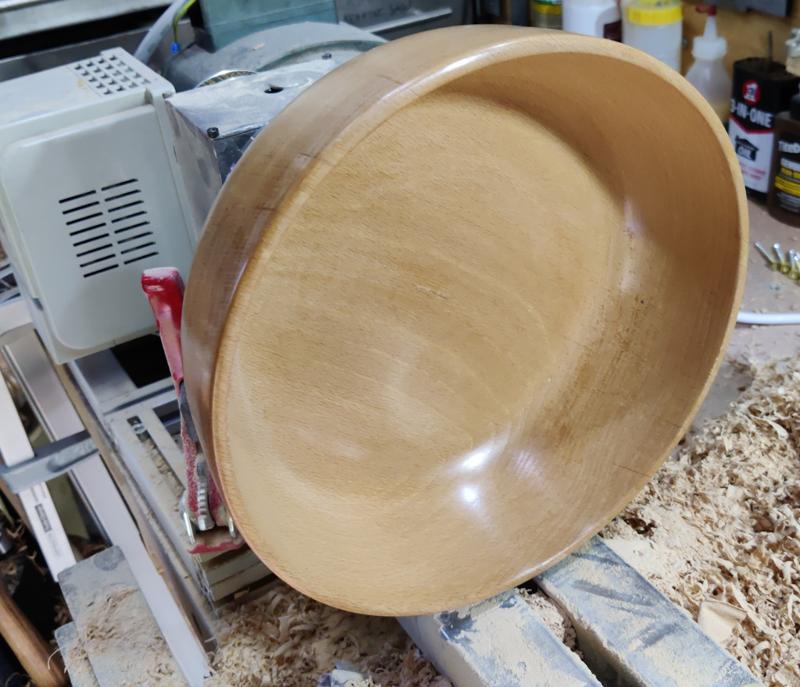
Once again, the final shape had a lot of scraping and then loads of sanding done. I probably could have kept going for much longer, but I was getting thoroughly bored of sanding and decided I'd had enough. The finished bowl still mounted on the lathe:

beech_bowl_finished_on_lathe_800.jpg


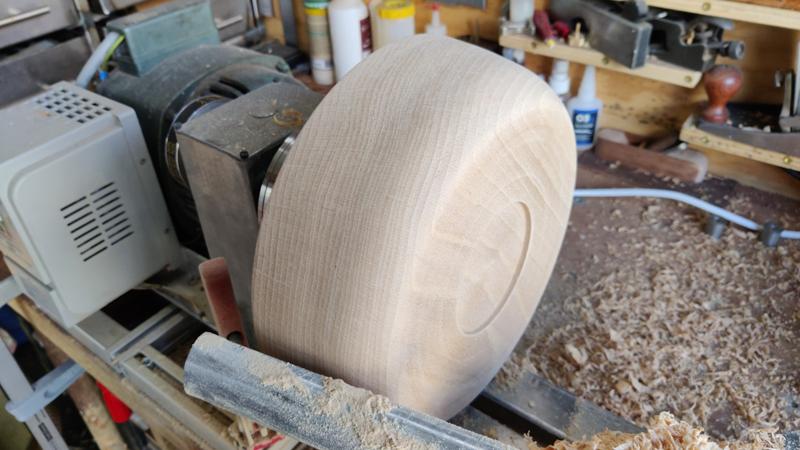
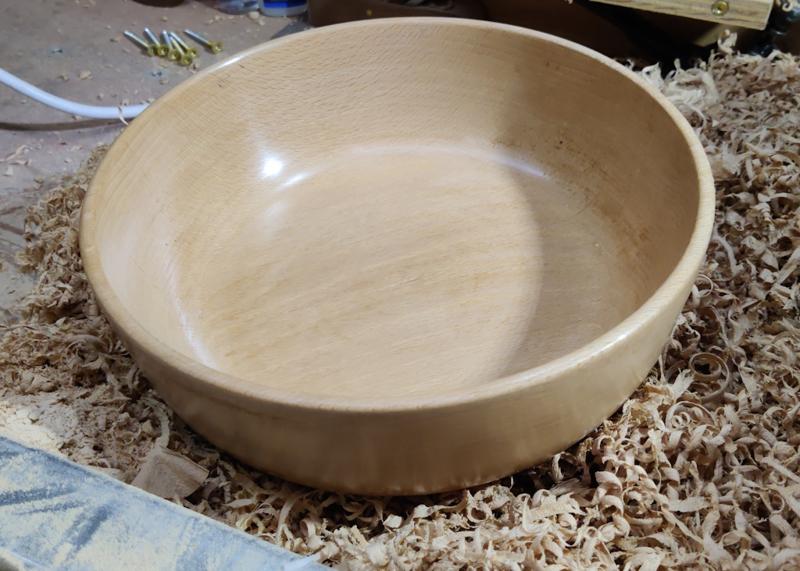
The final photo shows it lying on a bed of its entrails!

beech_bowl_finished_on_shavings_800.jpg
 
Are you sure you haven't done this before?

Great stuff!!

And I love the engineer's approach of immediately testing the new tool to its designed limits.
 
Nice bit of spinning on the new lathe. If I could offer a suggestion for your next venture on 'the Dark Side', in my very 'umble opinion, bowls always look better if you can turn the walls an even thickness from the rim to the base. Sometimes though, things can go drastically wrong, as in this little rosewood pot with a 2mm rim:

PHOTO-2024-03-26-17-50-59.jpg

...that exploded on me last week! :lol: Merely a suggestion and apologies for the :text-threadjacked: - Rob
 
Woodbloke":5tqcv5he said:
Nice bit of spinning on the new lathe. If I could offer a suggestion for your next venture on 'the Dark Side', in my very 'umble opinion, bowls always look better if you can turn the walls an even thickness from the rim to the base.

I agree with you and I was trying for that. To be honest, I stopped a little shy of "even thickness" (although I got quite close) mostly because I got bored and just wanted the bowl to be finished. I'm looking forward to getting back to some flat planks and some good old fashioned plane & chisel work :)
 
I was using the lathe again this morning to make another tool handle and I noticed that there was a lot of vibration. After a quick investigation, it became clear that the motor pulley was wobbling on the motor shaft and that was making the motor vibrate. I'm sure I could deal with it by clamping the motor assembly down better (it was only held to the bench with one clamp), but I'm not happy about the level of vibration.

I mentioned in an earlier post that the motor pulley had been a pain to fit as the shaft of the motor turned out to be wider at the end than at the base. I think what's causing the vibration is that the pulley doesn't have a perfectly fitting hole in the middle (as it needed to be enlarged to get it over the end) and hence it's moving back and forth a bit as the shaft rotates. The only decent way I can think of dealing with this is to sort out the motor shaft (and then make a new pulley).

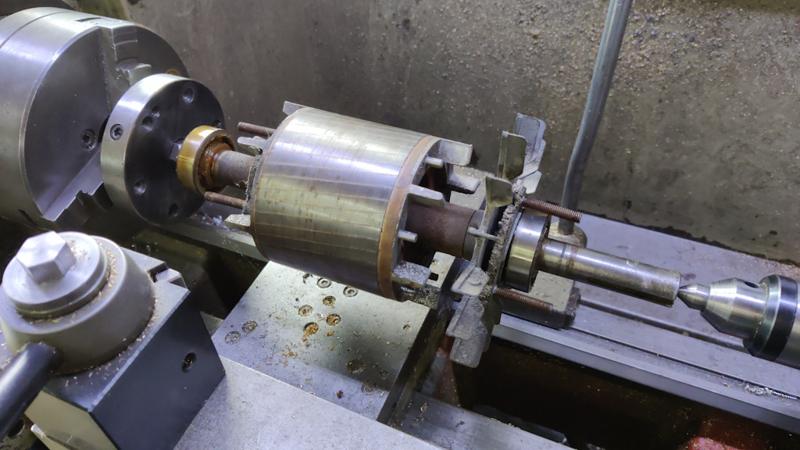
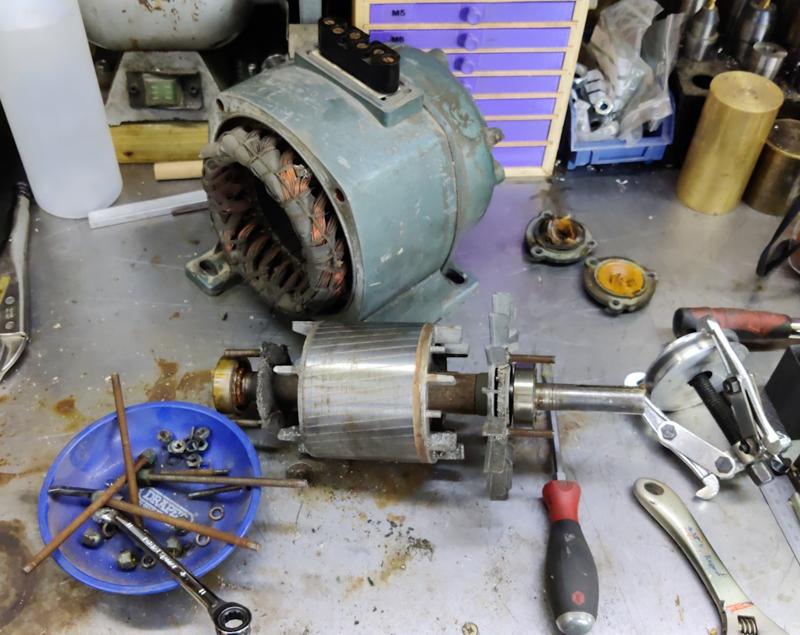
The first step was to dismantle the motor to have a better look at what's going on:

dismantled_motor_800.jpg


I mounted the shaft between centres on the lathe to see whether that would allow it to run fairly true (and hence give me a relatively easy way of making the shaft a consistent diameter and concentric with the motor axis).

mounted_between_centres_800.jpg


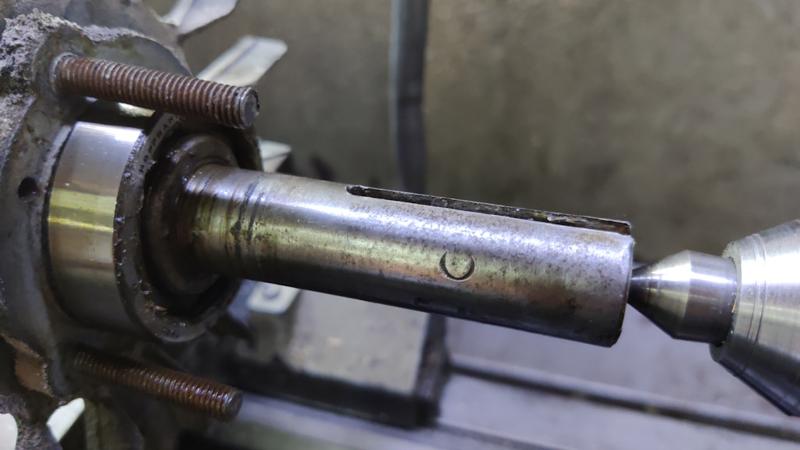
Running the lathe at a low speed (and with no drive dog, so just relying on friction to spin it), it was obvious that the shaft wasn't running true relative to the two centres. This is a close-up of the questionable end:

close_up_of_end_800.jpg


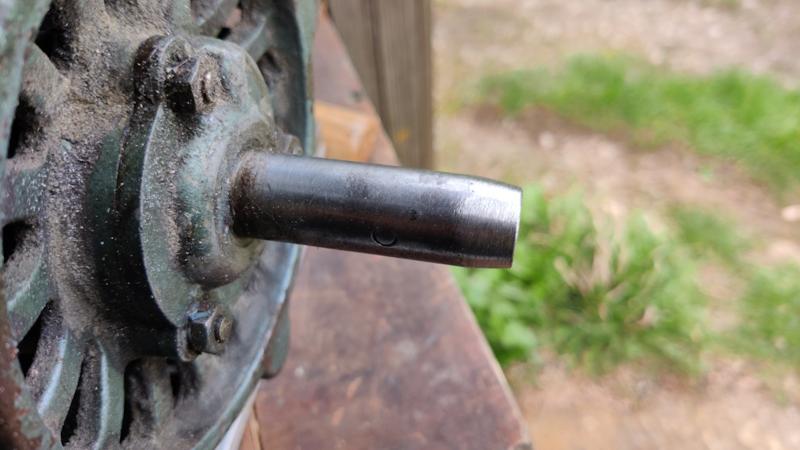
It's not that obvious in the photo, but the tip balloons out a bit. The bearing sits on a register that looks to be 19.05 mm (3/4"), so there's no way I'd be able to get the bearing (and hence the retention plate and the fan) off without first doing something about the end of the shaft (the shaft end is 19.35 mm at the tip). To make things even more difficult, the shaft has been hardened, so turning it won't be trivial.

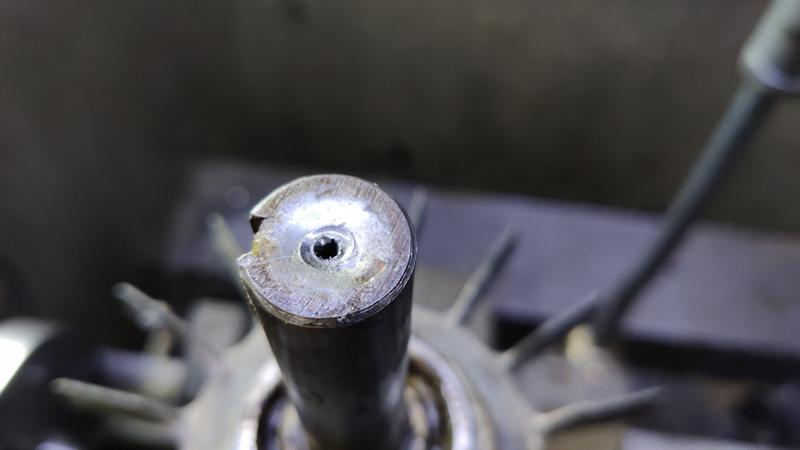
Looking at the end of the shaft, it's clear that it has had some abuse at some point in its life: the centre hole looks pretty awful (which won't have helped it run true when mounted between centres):

mashed_centre_hole_800.jpg


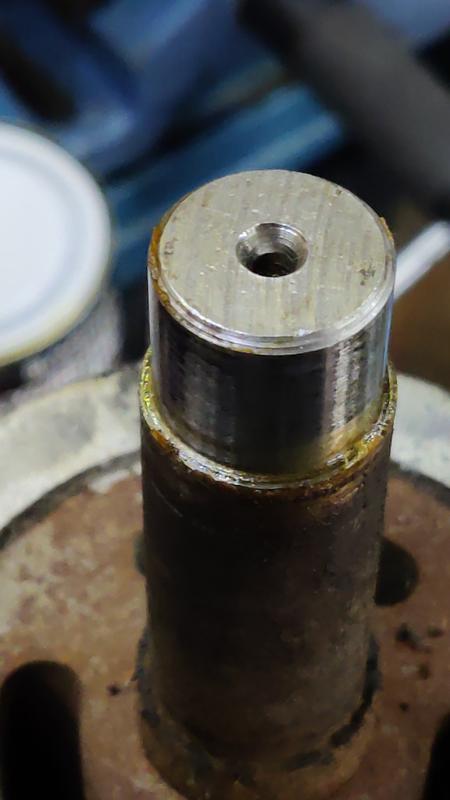
Compare that with the centre hole on the other end of the shaft, which looks a lot better:

better_centre_hole_800.jpg


I'm not sure what to do about this to be honest. I've thought of a few approaches, but none seem great.

Approach 1:

  • Re-assemble the motor
  • Run it and, while running, use an angle grinder to get the end of the shaft down to less than 19.05 mm.
  • If there's enough 19.05 mm shaft left to be usable and it runs concentrically with the bearing, stop there.

Approach 2:

As approach 1, but assuming the shaft isn't looking sufficiently usable after the angle grinder attention.

  • Pull the bearing, bearing backing plate and fan off and then re-fit the bearing.
  • Mount the shaft on the lathe, using a fixed-steady to support the outside of the bearing.
  • Try skimming the shaft with some carbide tools to get a smooth shank at some diameter or other (< 19.05 mm)
  • If I'm not feeling confident in the concentricity of the result, reduce the diameter even further (< 15 mm probably) and shrink fit a (non-hardened) sleeve over the top, then reassemble the motor and mount the entire motor to the bed of the lathe and run the motor while turning a new concentric shank from the non-hardened sleeve.

Approach 3:

  • Just cut the end with an angle grinder, hopefully leaving enough of a concentric section to be usable (similar to approach 1, really).

I'm probably leaning towards approach 1 (with a lot of hoping that I can do it without having to resort to approach 2), but I'd welcome any other suggestions.
 
Are you sure you haven't done this before?

Great stuff!!

And I love the engineer's approach of immediately testing the new tool to its designed limits.

Agree!

(what we dont see is the other workshop next door with a wood lathe churning out bowls! :) )
 
I decided to go with Approach 1: grind the end down a bit and rely on there being enough concentric shaft left after the mangled bit at the end. I started by reassembling the motor (with some fresh grease in the bearings as it seemed sensible while the motor was apart) and then got the motor spinning. A flap disk in the angle grinder applied a slight chamfer thing on the end. Once it got this far, I measured it and couldn't find any area where the diameter was over 19.05 mm, so I stopped:

ground_off_end_800.jpg


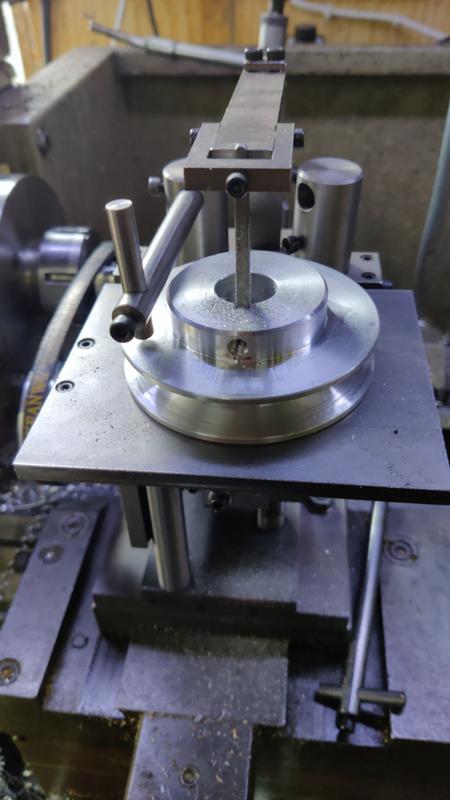
I then had to make a new pulley (as the old one had an oversize bore). That was done in much the same way as the old one, with the only difference being that I used my home-made filing machine (aka die filer) to cut the keyway and that I drilled and tapped a hole for an M6 grub-screw (which was always the intention on the original one, but the original one went on so tightly that it didn't seem worth bothering with):

filing_machine_800.jpg


With that done, I could reassemble the lathe and give it a test spin. I was feeling confident so I decided to spin it up without any clamps holding it down to the bench. It ran smoothly up to speed with no noticeable vibrations and stayed put on the bench. That's much better than it was before. I'll still clamp it down when I'm doing any turning, but it's nice to know it runs well without the clamps. It had seemed okay when I did the first few bits of turning with the lathe, but the vibration had been getting steadily worse. I'd guess that the pulley bore being a bit mashed by the end of the motor shaft meant that it wobbled a bit and that caused wear on the pulley bore, which meant it wobbled a bit more and so on. Hopefully the new pulley will last a lot longer now that the motor is sorted.
 
I did a couple of little jobs on the lathe this morning. Firstly, I took the tailstock off and used a couple of different flap disks (40 grit and 80 grit) to round off all the corners a bit. Part-way through...

grinding_corners_wip_800.jpg


... and done:

grinding_corners_done_800.jpg


It doesn't look super pretty, but it'll do the job (and will look a lot better if I ever get round to painting it, assuming I do a better job of painting than I normally do!)

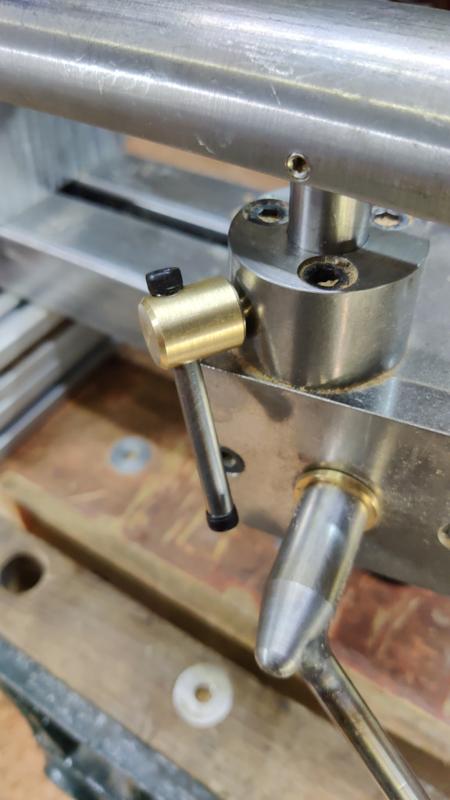
I also modified the tool post handle to have a sliding tommy bar rather than a fixed one:

new_handle_800.jpg


The fixed handle worked well for spindle work but in one case when I had the toolpost at a very strange angle for making a bowl, it got in the way a bit. Having a sliding tommy bar seemed the easiest solution.
 
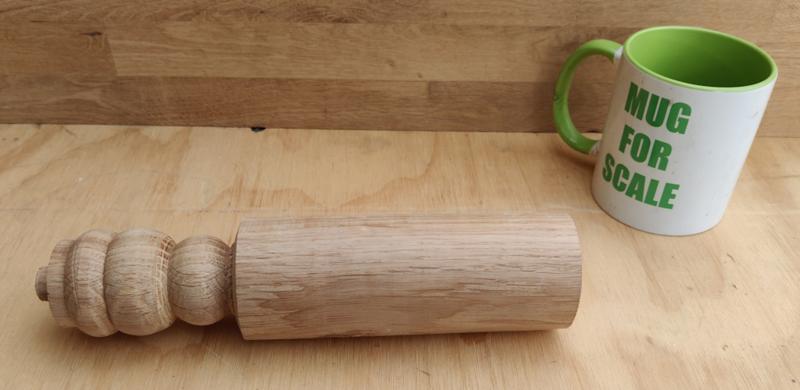
I haven't been using the lathe much over the last few months, but I wanted to have a bit more of a go to try to improve my turning skills. Following some sound advice from @AndyP of this parish, I did a one-day woodturning course on Saturday with Paul Hannaby in the Forest of Dean. The morning was spent making this out of a lump of oak:

20240826_01_skew_practice_800.jpg


Okay, that doesn't look like much, but the idea wasn't to make something pretty, it was just to practise skew chisel techniques. It started off with practising getting a good finish on relatively straight sections, then we did some peeling cuts to reduce the diameter followed by cutting into a corner with a good finish. We then went on to cutting V-grooves and finally beads. I'd never tried cutting beads with a skew chisel so that was really quite challenging and the advice and suggestions were really helpful.

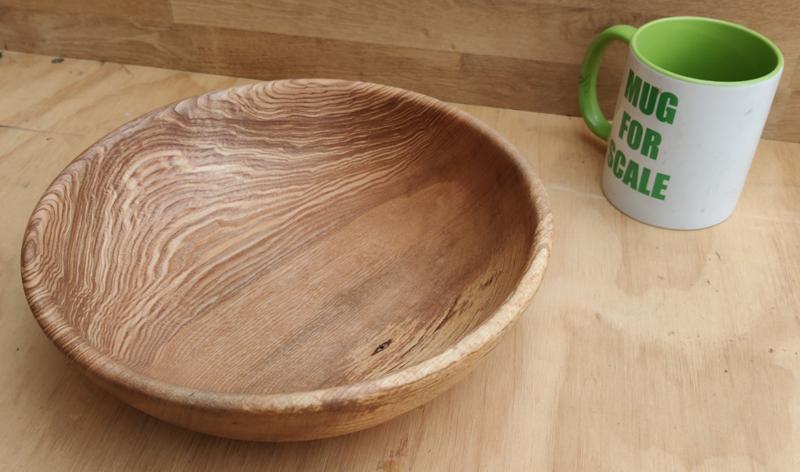
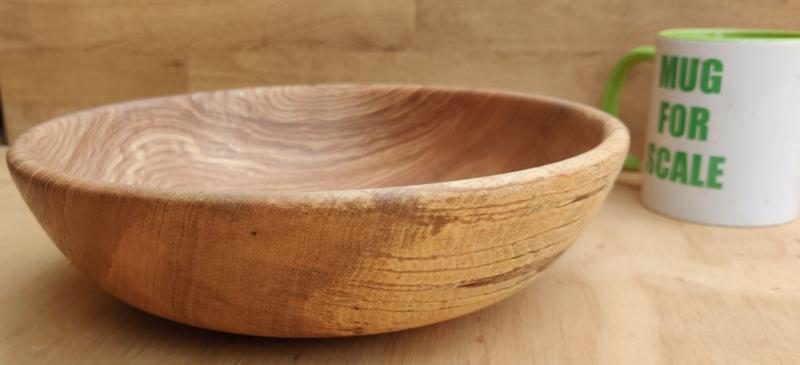
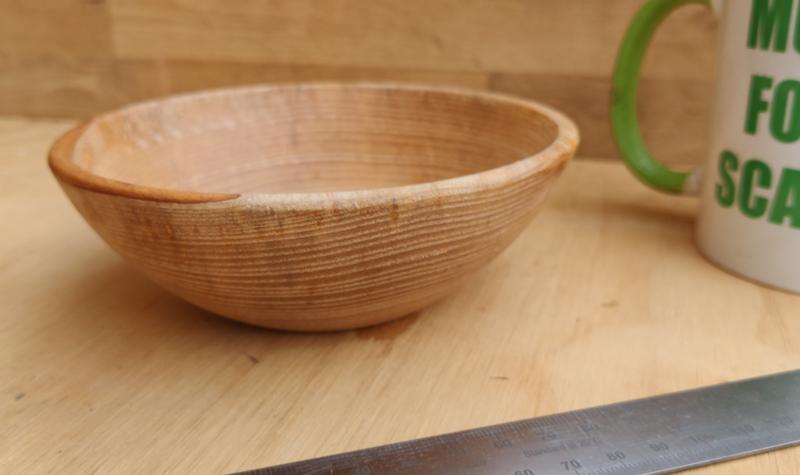
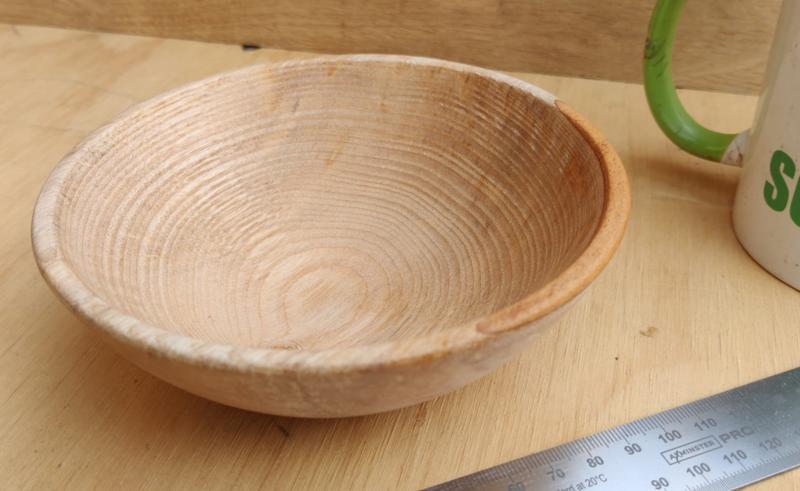
I started off the afternoon by making a bowl out of a lump of ash:

20240826_02_bowl_1_800.jpg


20240826_03_bowl_2_800.jpg


That was really instructive and definitely helped me feel a lot more comfortable using a bowl gouge than I had before the course. I decided to leave it unfinished during the course (to save time) and instead applied Mike's Magic Mix after I got home.

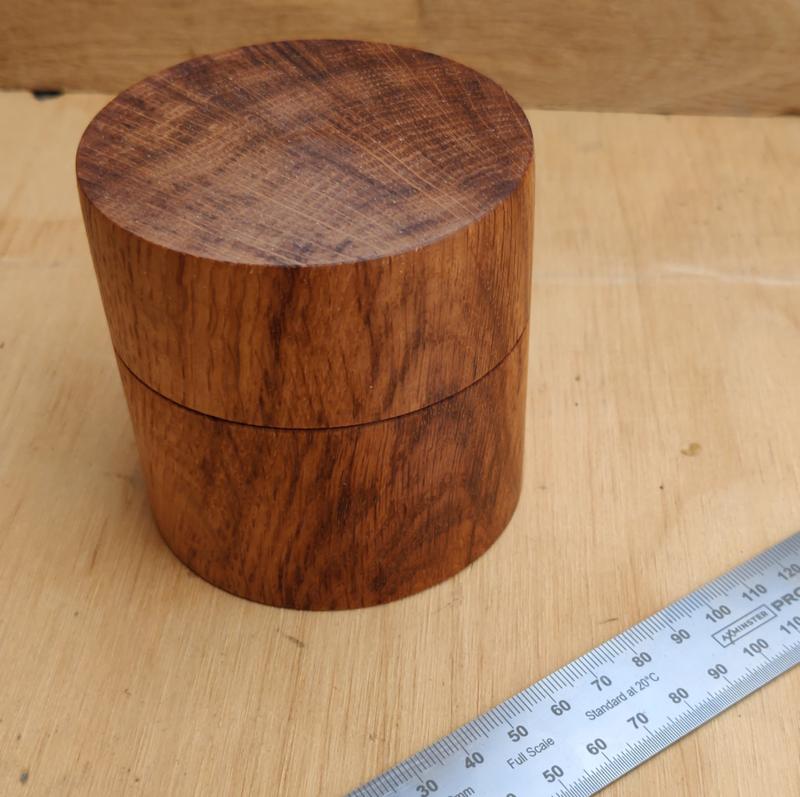
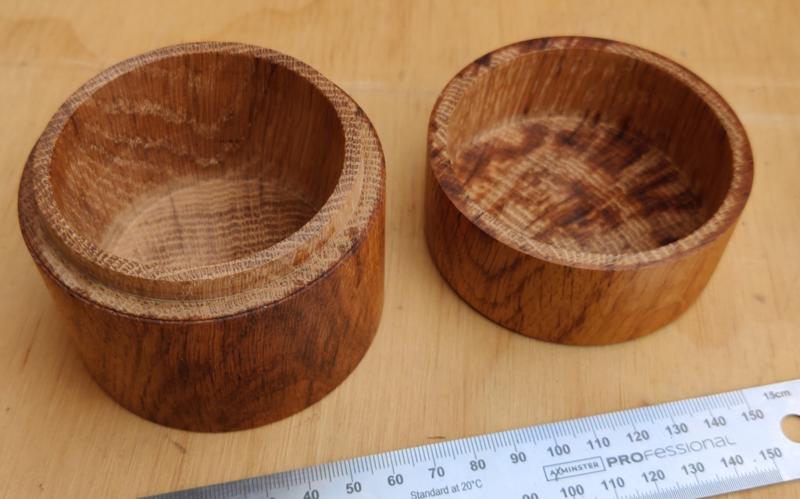
Once the bowl was finished, I made a small box out of brown oak (again finished with Mike's Magic Mix after I got home):

20240826_04_box_1_800.jpg


20240826_05_box_2_800.jpg


I really enjoyed making that box and I'd like to have a go at one myself sometime soon (although I might cheat and use a Forstner bit rather than doing everything with the lathe tools). He had a home-made hollowing tool that worked extremely well for cutting the sides and bottom of the box; I've ordered some 300 mm lengths of 12 mm high-speed steel so I can make one for myself (along with a round, square-ended skew chisel that makes beads much easier).

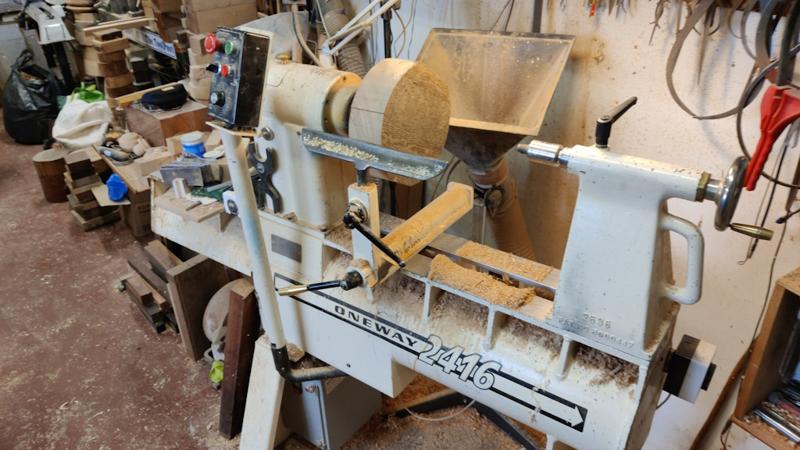
None of the above was done on my little lathe: I used Paul Hannaby's beast:

20240826_06_big_lathe_800.jpg


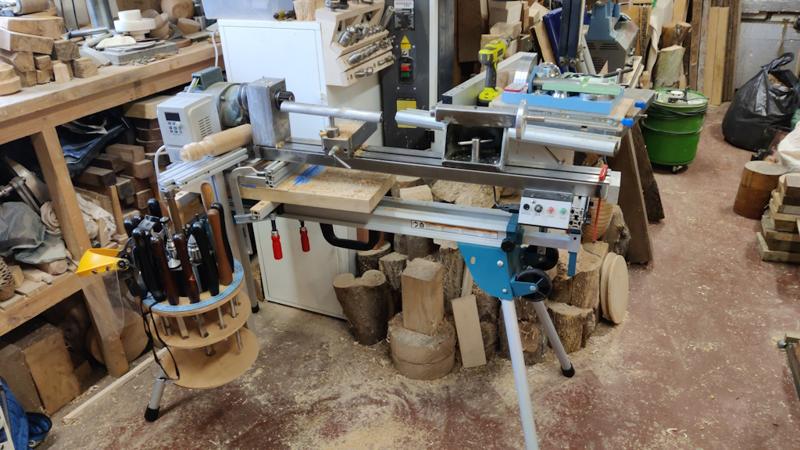
However, I did take my lathe along to the course and set it up on a mitre saw stand:

20240826_07_mitre_stand_lathe_800.jpg


That enabled me to try the odd technique (mainly skew chisel stuff) on my own lathe so that I could convince myself that the improvements I was seeing in cutting action were a result of what I'd learnt and not just down to using a "proper" lathe.
 
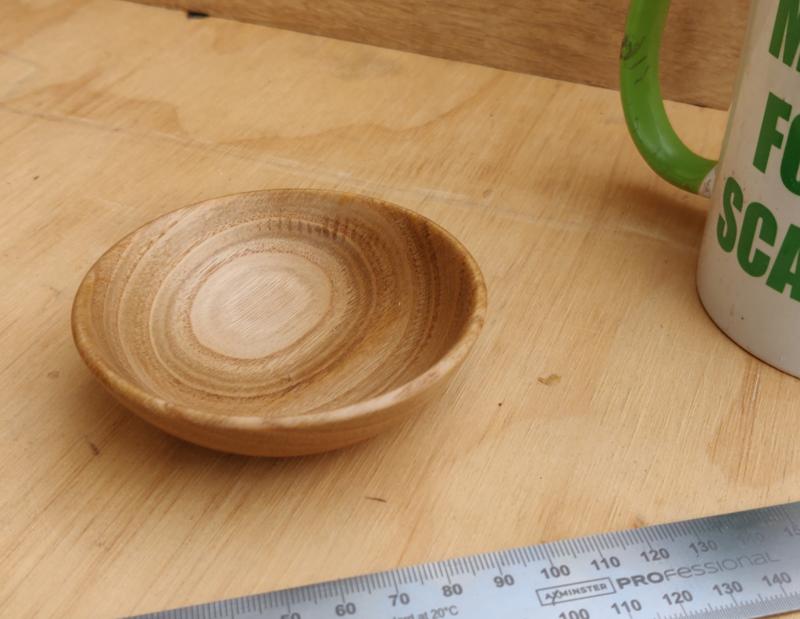
Since getting back from the woodturning course, I was keen to have a few more goes at all the techniques as soon as possible in order to fix them better in my mind. I started off by slicing off a tiny little bit of sweet chestnut from one of the offcuts from my garden table project. The offcut was about 70 mm square and about 35 mm thick and it was soon turned into this diminutive little bowl (again finished with Mike's Magic Mix):

20240826_08_tiny_bowl_800.jpg


Feeling buoyed by the lack of any dig-ins when turning that, I then got a slightly bigger blank (ash this time) and turned this simple bowl:

20240826_09_ash_bowl_1_800.jpg


That one was finished with Mike's Magic Mix as per the previous bowls.

20240826_10_ash_bowl_2_800.jpg


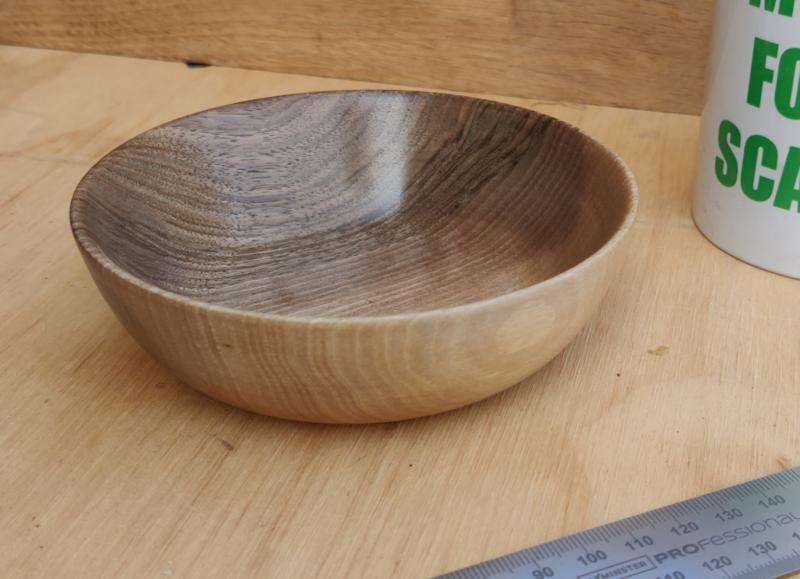
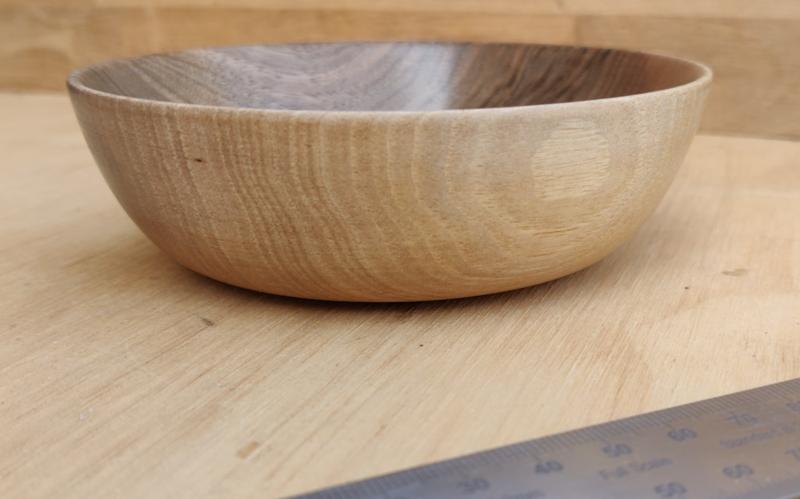
Finally for now, I got a pretty looking bit of English walnut and made yet another bowl, this time finishing with sanding sealer and beeswax.

20240826_11_english_walnut_bowl_1_800.jpg


20240826_12_english_walnut_bowl_2_800.jpg


I'm feeling a lot more confident with bowl work now. All the ones I've made at home have needed a fair amount of sanding on the inside surface to get rid of small ripples, but I think there was less and less as I made each one. The bowl gouge shear scraping cut that Paul taught me definitely helped with getting a good finish on the outside, as did the use of a hot-melt glue stick as a test to see whether the outside shape of the bowl was "fair" (bending the glue stick over the rim of the bowl and then sighting along the rim to look for light under the glue stick).

The next thing I think I'll do is a bit of practice with the skew chisel on that oak spindle to try to cement those techniques into my muscle-memory.
 
I don't think you'll need to go to the shops to buy Christmas presents this year. Excellent stuff!
 
Getting the bottom of a box or bowl reasonably square with a flat base is hard going. I bought the Jason Breach set of tools which he designed specifically for this purpose; effective but not cheap. Then again Christmas is within sight! - Rob
 
Getting the bottom of a box or bowl reasonably square with a flat base is hard going. I bought the Jason Breach set of tools which he designed specifically for this purpose; effective but not cheap. Then again Christmas is within sight! - Rob

This is the one that I used with Paul Hannaby - it's something he had ground himself out of another tool of some sort:

1724677696771.png

It's got two edges at slightly less than 90° from one another, both with relief under the tip. As you can see, the side edge is off-angle from the shank of the tool so that it can be used to run all the way down the inside edge of the box without the tool shank touching anything. You then angle the tool slightly to lift the heel of the edge away from the box side and use the end of the tool to cut the base of the box.

That tool did the entirety of the inside of the box (hollowing and then doing a light pass for a good final finish) and made it quite an easy job. It'll be the first thing I make when the HSS bar I've ordered arrives as I think it should be very simple to make on a bench grinder.

I guess something similar could be used for the inside of a bowl; the challenge with scraping bowls seems to be going smoothly round the bend (so to speak). On the course (and on the bowls I've made since getting home) I just used the bowl gouge, following the approach that Paul Hannaby showed me. Hopefully with practice that will get easier, but it was particularly difficult on the last (walnut) bowl, which has steeper sides and hence a fairly small radius corner at the bottom.
 
Addictive innit Al?

I bet rocking up at the course with your lathe raised an eyebrow or two.

The bowls look great by the way. Are you signing them? I know Rob likes to note the wood species on his pieces too.

And don’t forget wood does not have to me a smooth and shiny as polished metal, in facts looks and feels better with a little character.
 
I bet rocking up at the course with your lathe raised an eyebrow or two.

I had pre-warned Paul that I was bringing it - I'm not quite so antisocial to just turn up at someone's house with a lathe in tow!

The bowls look great by the way. Are you signing them? I know Rob likes to note the wood species on his pieces too.

I haven't yet, but I probably should. I've been meaning to get a stamp made for a while but never quite manage to settle on a design. Recording the species seems like a good idea as it can be hard to keep track (although that's one of the benefits of maintaining a website of my projects: I can go back and look at what I wrote about them when I made them!)

Just noticed Al’s post from 1st April

Were you fooling us?:)

Probably... I didn't particularly expect to make many more bowls (I still don't enjoy it anywhere near as much as I enjoy, for example, planing flat bits of wood), but I do want to get better at techniques so that when the time comes to make something as part of another project, I can just do it without too much difficulty. I'm not sure the techniques involved in making bowls are that applicable to the stuff I'm likely to make long term, but who knows? Conversely, I really enjoyed making the brown oak box with Paul, so I definitely want to have a go at more turned boxes at some point.

Despite saying I don't enjoy it as much as planing, I must admit that it's quite satisfying being able to go out to the workshop and make something in under an hour start-to-finish (compared to, say, 11 months for my tool chest :D). Of course the danger there is that you rapidly end up with more bowls, pens and boxes than you know what to do with :)

As an aside, I'm also making a couple of upgrades for the lathe. One of them I've already finished (and you can see in the picture above if you look really closely) and was always part of the plan (but wasn't included in the original build as I didn't have the necessary material and I was trying to make it from stuff I had in stock). The other is a fairly minor addition that will be appearing on the lathe soon and won't make a lot of difference to how it looks but should make one job slightly easier. You'll have to stay tuned to find out more :)
 
As for the stamp I am sure with your skills you could make a branding iron.

One of the aspects of turning I have enjoyed is the decorating and segmenting and although I am nowhere near CHJ’s or Dalboy’s level but working out how to do stuff is more than half the pleasure. See here for example https://www.thewoodhaven2.co.uk/threads/why-turning-is-more-than-pens-and-bowls-to-me.9428/

I have half a mind to make a copy turning “jig” and have a go at a chess set. I’ve made a start (screwed two bits of wood together) but don’t expect rapid progress.
 
I haven't been using the lathe much over the last few months, but I wanted to have a bit more of a go to try to improve my turning skills. Following some sound advice from @AndyP of this parish, I did a one-day woodturning course on Saturday with Paul Hannaby in the Forest of Dean. The morning was spent making this out of a lump of oak:

20240826_01_skew_practice_800.jpg


Okay, that doesn't look like much, but the idea wasn't to make something pretty, it was just to practise skew chisel techniques. It started off with practising getting a good finish on relatively straight sections, then we did some peeling cuts to reduce the diameter followed by cutting into a corner with a good finish. We then went on to cutting V-grooves and finally beads. I'd never tried cutting beads with a skew chisel so that was really quite challenging and the advice and suggestions were really helpful.

I started off the afternoon by making a bowl out of a lump of ash:

20240826_02_bowl_1_800.jpg


20240826_03_bowl_2_800.jpg


That was really instructive and definitely helped me feel a lot more comfortable using a bowl gouge than I had before the course. I decided to leave it unfinished during the course (to save time) and instead applied Mike's Magic Mix after I got home.

Once the bowl was finished, I made a small box out of brown oak (again finished with Mike's Magic Mix after I got home):

20240826_04_box_1_800.jpg


20240826_05_box_2_800.jpg


I really enjoyed making that box and I'd like to have a go at one myself sometime soon (although I might cheat and use a Forstner bit rather than doing everything with the lathe tools). He had a home-made hollowing tool that worked extremely well for cutting the sides and bottom of the box; I've ordered some 300 mm lengths of 12 mm high-speed steel so I can make one for myself (along with a round, square-ended skew chisel that makes beads much easier).

None of the above was done on my little lathe: I used Paul Hannaby's beast:

20240826_06_big_lathe_800.jpg


However, I did take my lathe along to the course and set it up on a mitre saw stand:

20240826_07_mitre_stand_lathe_800.jpg


That enabled me to try the odd technique (mainly skew chisel stuff) on my own lathe so that I could convince myself that the improvements I was seeing in cutting action were a result of what I'd learnt and not just down to using a "proper" lathe.
That is a very impressive lathe you made Dr.Al. Is there much vibration when turning using the mitre stand?
 
That is a very impressive lathe you made Dr.Al. Is there much vibration when turning using the mitre stand?
Thanks duke. I haven't noticed much vibration but there are a couple of caveats there:
  1. It's a very heavy duty mitre stand.
  2. I've only used it on the mitre stand for very light duty stuff: mostly skew chisel practice after already having turned the oak blank down to a cylinder. All the bowls and such-like I've made have been done with the lathe clamped down to my woodworking bench. The only reason I put it on the mitre stand was to take it to Paul Hannaby's place.
 
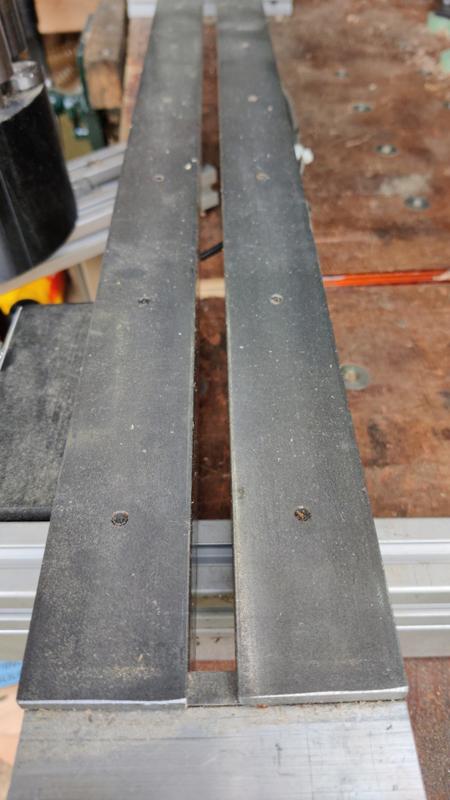
The lathe has had a couple of minor upgrades since I finished it a few months ago. The first of these was something that I was always considering doing but didn't as I didn't have the required material (and I was trying to make it from what I had in stock). I've since bought a couple of metre long 40 mm × 8 mm steel bars, so these got attached to the bed with some screws from underneath:

bed_with_steel_bars_800.jpg


This was just a case of drilling and tapping a row of holes in each bar and then drilling the box section through with a clearance drill and then opening out the bottom side of the box section to allow clearance for the head of a cap screw. The bars could then be clamped around some 12 mm thick spacers (to get the two bars perfectly parallel) and then screwed to the bed.

holes_under_bed_800.jpg


The advantage of this upgrade is that it guarantees that the two sides of the bed are parallel for the whole length. A little bit of distortion is inevitable when welding, so there was a very slight bow in the box section. It was much more minor than I expected and probably would have been fine: with the tailstock adjusted to be a snug but sliding fit in the middle of the bed, it ran smoothly but snugly along most of the bed but was a bit too tight in the last 60 mm or so near the right-hand end of the bed. For all but the longest spindles, that wouldn't have been a problem but with the extra bars added it runs smoothly along the entire length of the bed and was also much easier to set up as I could ditch the eccentric 11 mm diameter adjuster pins shown in this image...

0303_tailstock_alignment_pins_4_adjustment_800.jpg


... and replace them with plain 12 mm diameter pins with a central 6 mm hole:

new_alignment_pins_800.jpg


The second modification was also fairly simple. When I visited Dolphin Antiques a few months ago, one of the cheap sets of chuck jaws I bought was a set of button jaws (also known as Cole jaws I believe). Since using them for a couple of bowls, I've found that they're slightly limited in that the bed clearance (centre height) isn't quite enough to allow the full range of chuck jaw movement when these jaws are fitted. With the jaws fully closed, there's plenty of clearance:

button_jaws_fully_closed_800.jpg


If the chuck jaws are opened all the way, the button jaw plates hit the bed:

button_jaws_partly_opened_800.jpg


There's enough travel there to be able to clamp down on most bowls but it's a bit marginal and it tends to require the bowl to be fitted before the chuck goes on the lathe, which just makes the whole process more awkward.

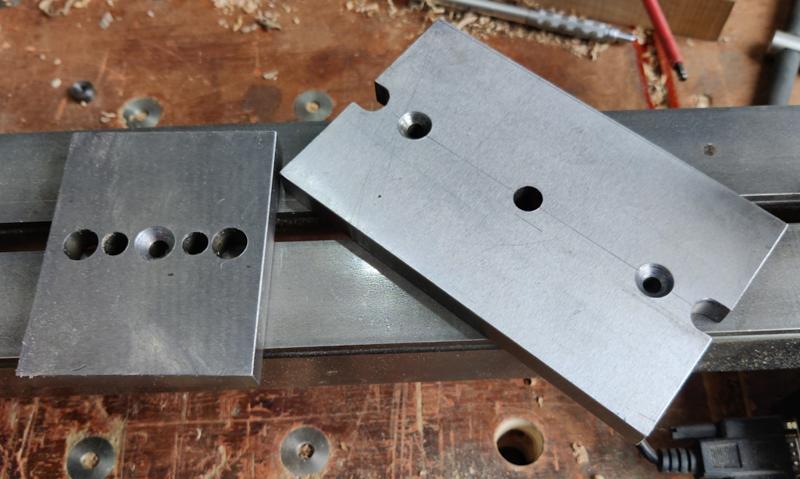
Conveniently, I had a handy lump of 12 mm thick steel plate in a drawer and it was big enough to be cut up to provide these two bits, which had the edges milled and a bunch of holes drilled:

height_raiser_plates_800.jpg


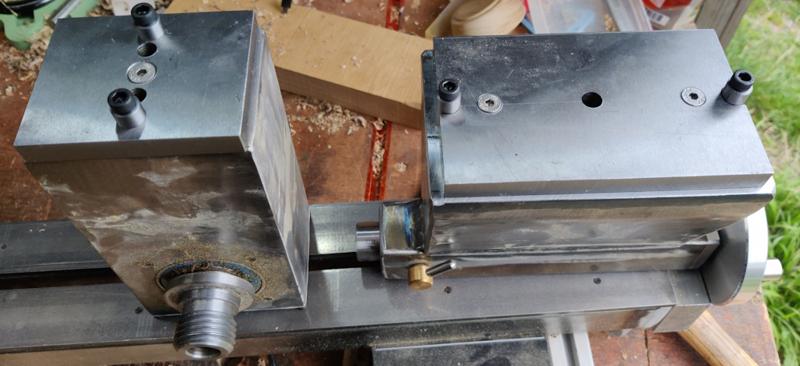
Those plates go under the head- and tail-stock and raise the centre height by 12 mm...

raiser_plates_fitted_800.jpg


... allowing clearance for the button jaws to be fully used:

button_jaws_with_spacers_800.jpg


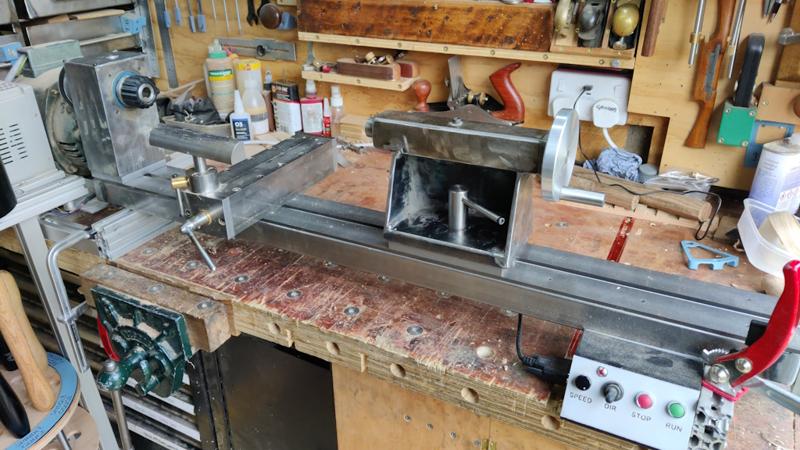
Overall view of the upgraded lathe:

lathe_with_spacers_800.jpg


The centre height of the lathe is now 140 mm, allowing a theoretical maximum diameter of 280 mm (assuming the blank was already circular and perfectly centred!)
 
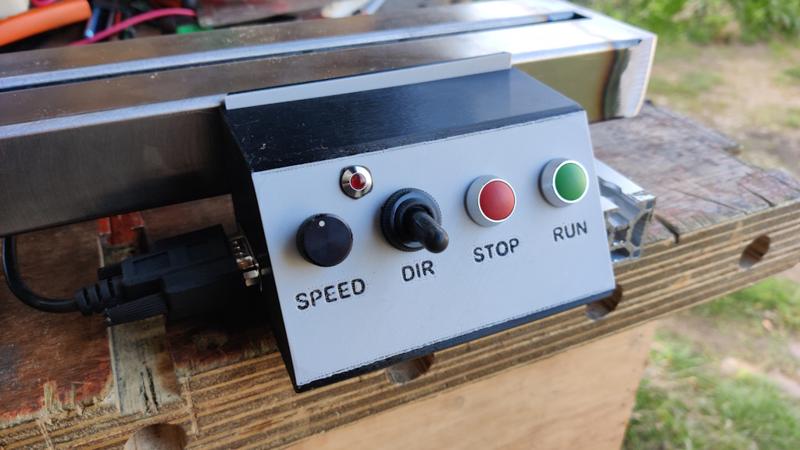
Replacing the control box for the wood lathe is something I'd been meaning to do for a long time, but I finally got round to fitting the updated version today. The previous little control box worked okay, but had a few of issues:

  1. The toggle switch for changing direction of rotation was relatively easy to knock by accident. Doing so would mean the lathe would run in reverse until I noticed that the switch had been flicked (or that the lathe was running backwards, which isn't always immediately obvious when it's spinning quite fast).
  2. The reversing LED (which was supposed to flash when the switch is in reverse position and help with #1) didn't work due to picking one that runs on 24 V (which is what the drive manual said was provided) but the drive actually only supplies 12 V. It's also very small, so wouldn't be especially visible even if it did work.
  3. The speed control was a bit limited. The variable speed drive I bought has a 5 V output for the high side of a potentiometer and an analogue input that can be used to set the speed. Unfortunately, the analogue input expects 0 to 10 V, so with the potentiometer connected to the 5 V output, I could only ever run the drive at up to half speed. I could have configured the drive so that the maximum speed was 120 Hz instead of 60 Hz or I could have added another resistor in-line with the 12 V output, but neither of them felt like a very good solution.

Out with the old...

0803_inverter_mount_07_control_panel_800.jpg


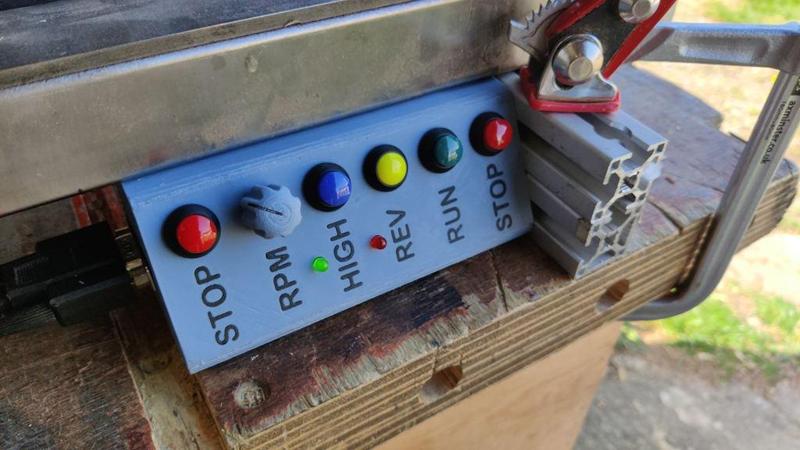
... and in with the new...

2025-05-02-01-new-control-panel-on-lathe_800.jpg


The new version has a few differences:

  1. The reversing LED (which flashes when in reverse mode) is bigger (5 mm diameter) and hence should be more visible. It also works, which is quite a big improvement!
  2. The toggle switch for changing direction has been replaced with a push switch (which has to be held down for at least 250 ms to do anything). When the lathe power is turned off and back on again, the direction will reset to forward rotation (a bit like a no-volt release circuit). The button for reverse is also slightly lower profile than the other buttons. All that should make it much less likely that I'll accidentally put the lathe in reverse.
  3. The control box runs entirely off the 12 V supply, with a couple of voltage regulators to generate a 5 V and 10 V internal supply. The button marked "High" switches the top end of the potentiometer between 5 V and 10 V (and turns on the new green LED when in 10 V mode). On power-up, it's connected to 5 V, so the dial gives finer control over the 0 to 50% (0 to 1800 rpm) speed range. When you press the button, it switches the potentiometer to being connected to 10 V and hence you get access to the full speed range (0 to 3600 rpm).
  4. I added an extra STOP button so there's one at each end of the box for easy access.

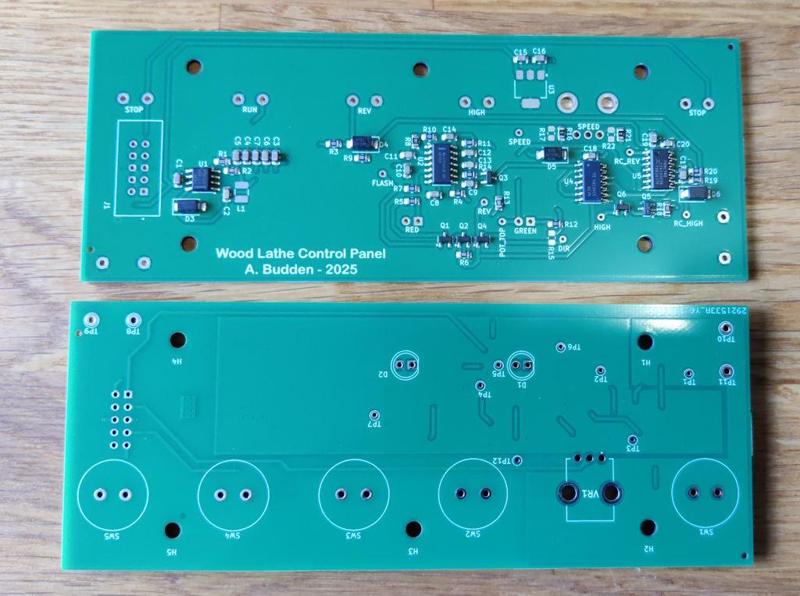
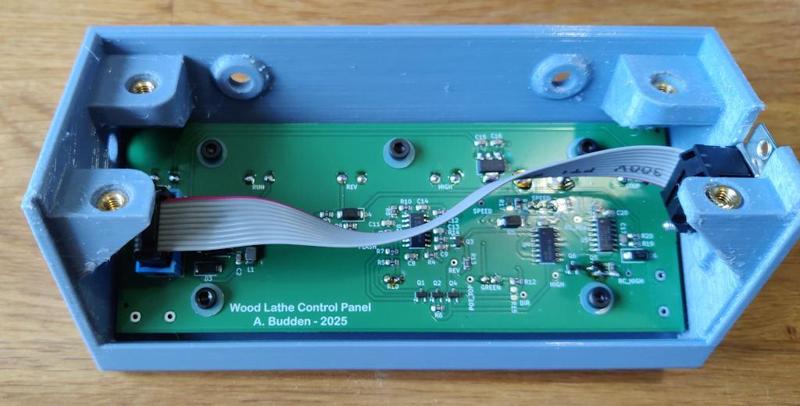
2025-05-02-02-pcb-as-received_800.jpg


Internally, it's implemented as a PCB that's soldered directly to the push buttons and potentiometer that come through the front panel. The photo above shows the PCBs as received. I got the PCB with the surface mount components fitted from JLCPCB; the total cost (for five PCB assemblies) including PCB manufacture, surface mount assembly and shipping to the UK was only £27.40. I only need one but the minimum PCB order quantity was five and the cost difference for assembling five vs two was small enough that I figured the spares might be handy. Two of the surface mount components I picked (one of the regulators and the inductor) weren't in stock at JLCPCB, but were readily available in the UK, so I just hand-soldered them when the boards arrived. I also had to hand-solder the through-hole components, but that's quite easy to do. Unfortunately I made a small mistake on the PCB design (I somehow managed to put one of the FETs the wrong way round: it's always three-pin components that go wrong) but I was able to bodge the board by removing the component and re-mounting it upside down and at a jaunty angle and that fixed the issue. It's not ideal, but it works.

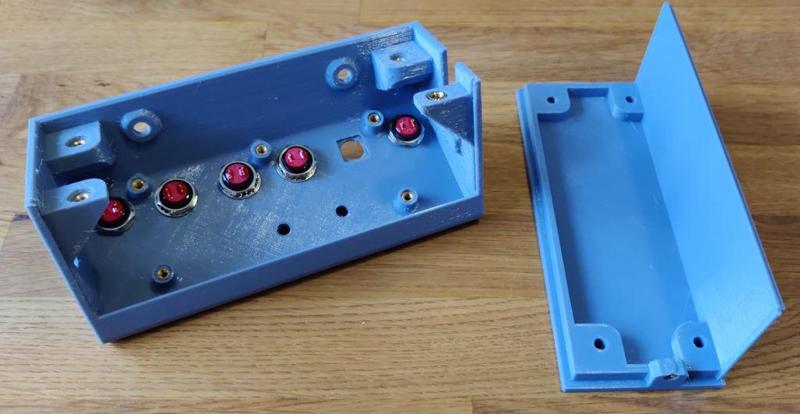
2025-05-02-03-box-as-printed_800.jpg


2025-05-02-04-inside-view_800.jpg


These photos show the box as-printed (with heat-set inserts inserted) and what it looks like with the PCB soldered into the box. As before, the box was 3D-printed. I used an emulated "multi-material unit" configuration (which needs a lot of tweaking, but worked okay-ish) to print the box, with about four manual filament changes inserted into the print process. That made a slightly nicer looking front panel with black filament filling in the text region rather than having debossed text with black layers as on the previous box.

The buttons, potentiometer and LEDs were hand-soldered after I'd fitted the PCB into the box.

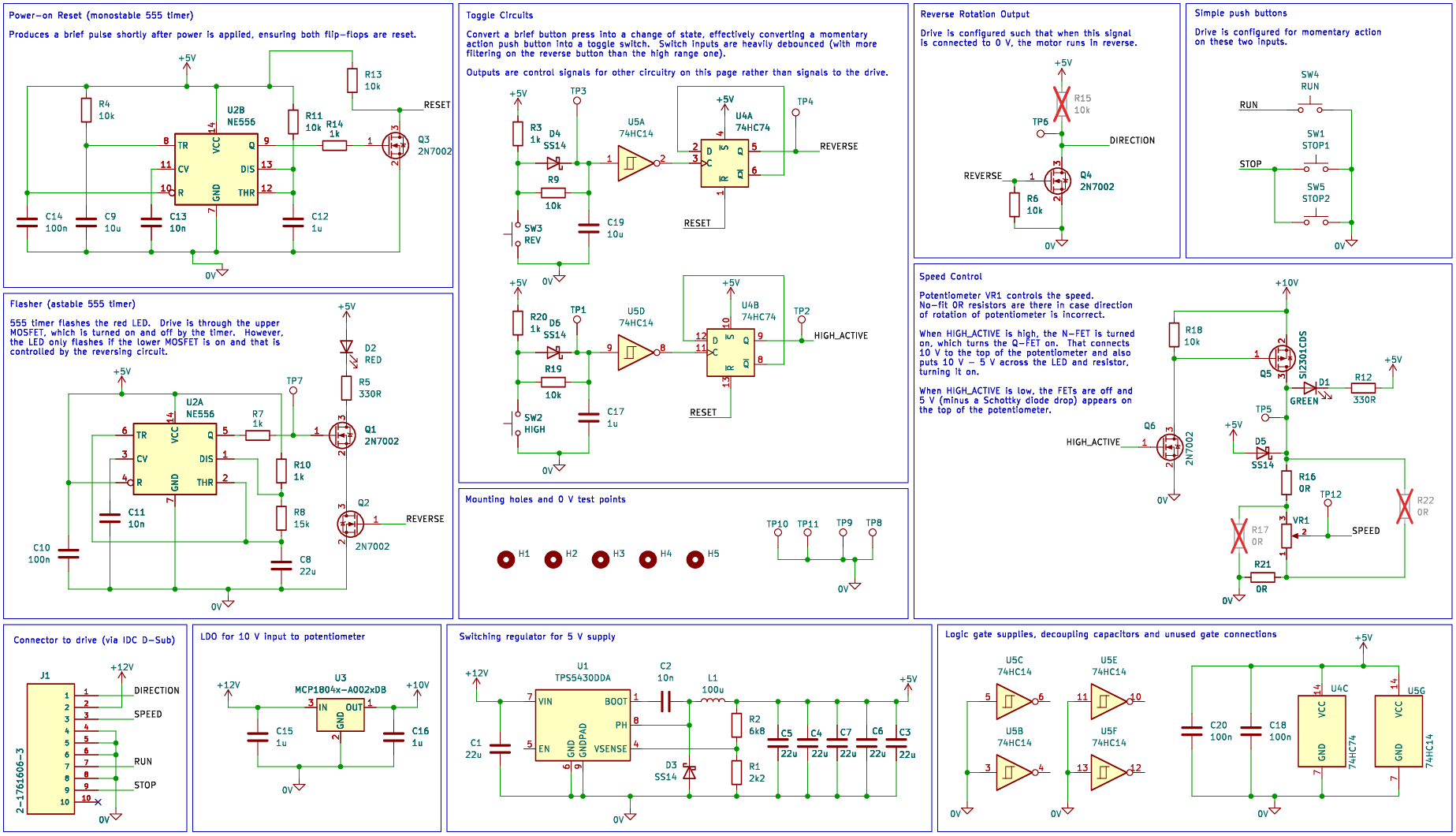
Below is the schematic (with the mistake corrected). There are some notes on the schematic, but I'm not going to go into further detail about how the circuit works; I'm happy to answer any questions that anyone has.

2025-05-02-05-schematic.png
 
I've decided to give the lathe a bit of a service and some minor updates. Having used it quite a lot earlier in the year making lots and lots of bowls, I've convinced myself that the lathe works perfectly well, but there are a few minor niggles that I'd like to address.

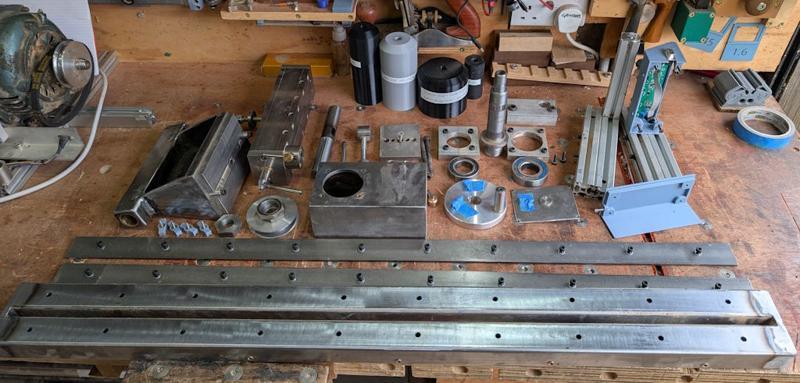
The first thing I did was dismantle the lathe:

2025-12-21-01-disassembled-lathe_800.jpg


The four plastic cylinders you can see behind all the lathe bits are some custom made bearing fitting/removing tools, three of which were 3D-printed and the fourth (which is just a cylinder with a hole in it) turned on the lathe out of some unknown plastic.

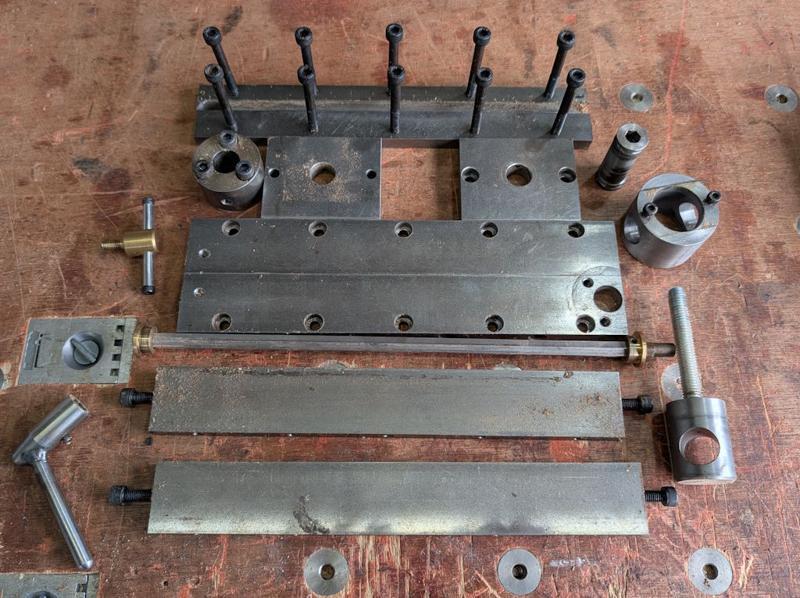
After taking that photo, I also decided to disassemble the banjo:

2025-12-21-02-disassembled-banjo_800.jpg


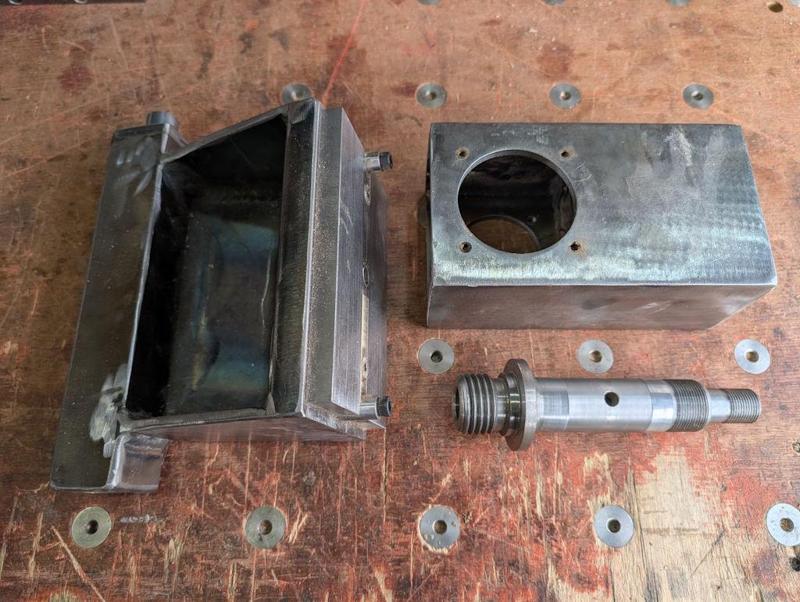
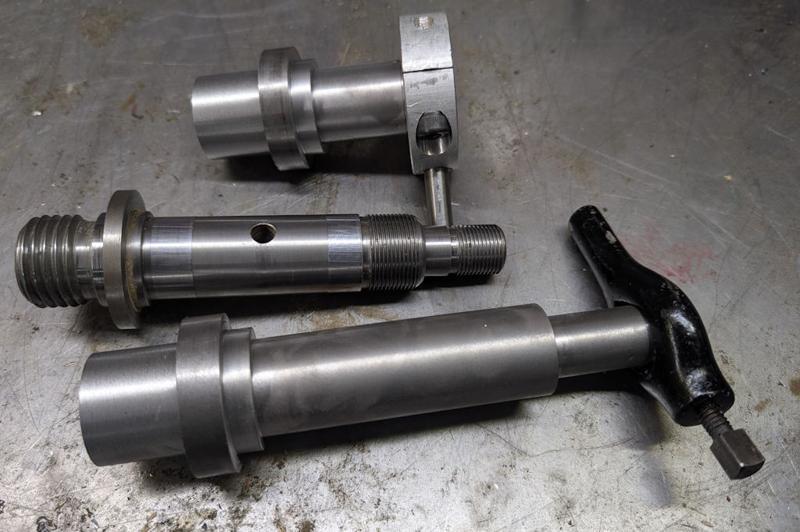
The main focus for the work will be these three parts:

2025-12-21-03-three-priority-parts_800.jpg


The tailstock is going to gain a cam-lock, which should improve the ergonomics a little. I'm going to make a completely new spindle (again!) and the headstock will get quite a few minor modifications, mostly involving drilling / tapping extra holes in it.

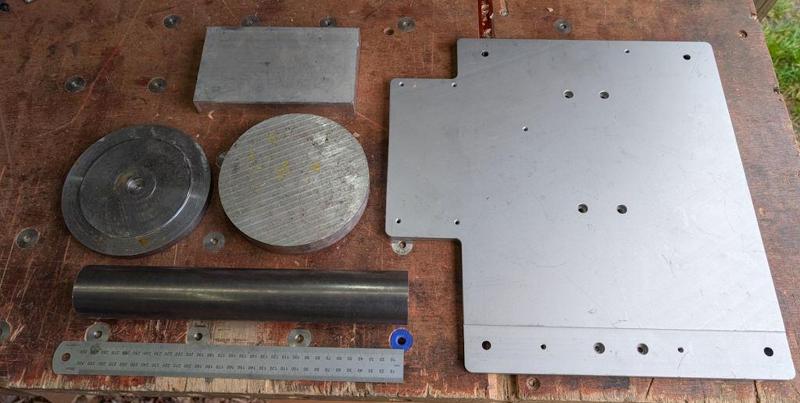
There are a few other modifications that will happen as well, mostly involving this little pile of material that (with the exception of the 50 mm EN1A bar at the front) came out of a skip:

2025-12-21-04-material_800.jpg


The 50 mm EN1A bar will become the new spindle (turned from solid this time rather than made in two parts with an interference fit). The lump of aluminium at the back will be cut in half and made into a new lid for the headstock. Only one of the discs will be used (but I haven't decided which yet).

More to follow; watch this space!
 
I think Mike is impressed,

a) That you can see scope for improvement, and
b) that you have access to some very high grade skips

- I know I am!
 
I decided to start with the new spindle. There are two reasons I want to do this, neither of which are really essential (and if I wasn't making other modifications to the lathe at the same time I doubt I would have bothered).

The first and arguably more important change is that I'm going to extend the rear of the spindle a bit (so it sticks further out from the back of the headstock). The reasons for that will become clear later.

The other change is that I'm going to tweak the shape of the spindle nose to match the ASR standard (a drawing of which I've managed to find on the web). The ASR standard includes an angled face on the rear of the register upon which the chuck bears. That angled face can be used with a clamp to hold the chuck on the spindle and stop it unscrewing (if the lathe is run backwards or when stopping if the chuck has significantly more momentum than the spindle).

Whether I'll ever use said clamp remains to be seen!

This ASR clamp is the reason I decided to make the spindle out of solid bar rather than doing an interference fit as before. If I just added the angled face onto the existing spindle, the clamp would bear on the 50 mm piece that was added to the main spindle. While it's vanishingly unlikely, there is a remote possibility that the 50 mm piece could come loose and come off the spindle along with the chuck and the clamp. I don't for a second think that it would actually happen, but considering it's intended as a safety feature it seems better to go belt-and-braces and make it out of solid.

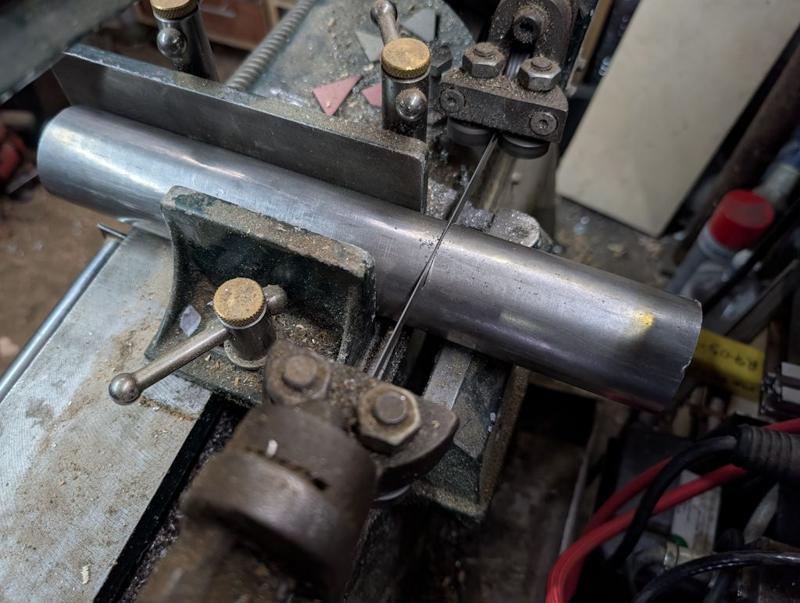
Right, that's enough waffle, onto some spindle making. I started by chopping the 50 mm diameter EN1A bar into two pieces, yet again feeling grateful for a horizontal bandsaw to do the hard work for me:

2025-12-21-05-sawing-bar-in-two_800.jpg


While I'm in spindle-making-mode, I'm going to turn the off-cut into an M33×3.5 spindle as well, but with a plain 30 mm shank on the back. That could be useful if I ever feel the need to mount any wood lathe chucks / face-plates on the metalworking lathe for any reason: the 30 mm shank will go in an ER40 collet and the chuck or face-plate would mount on the threaded nose.

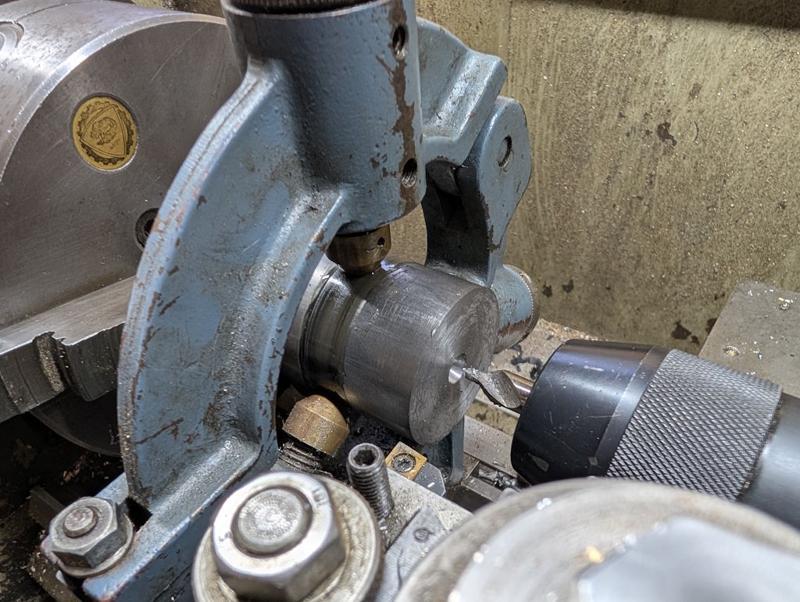
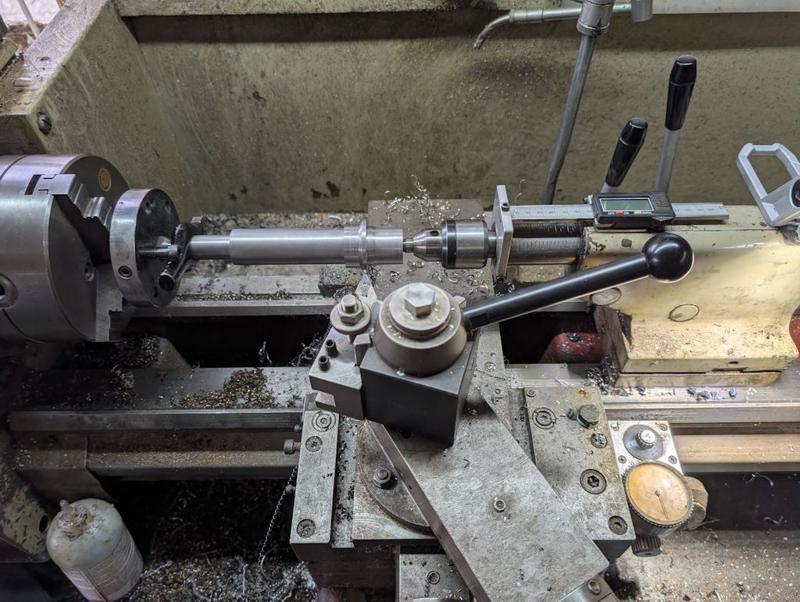
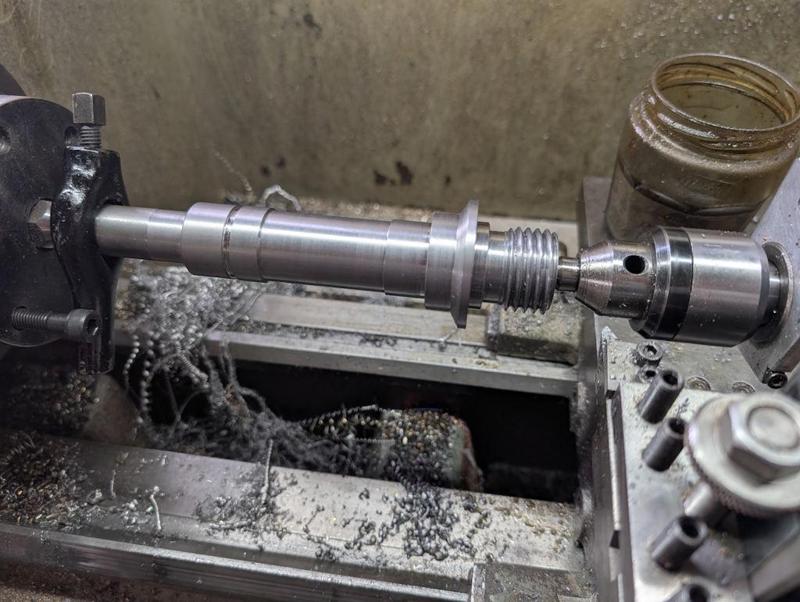
I started with the off-cut first, holding it in the chuck and, with a fixed steady supporting the outer end, facing it and drilling a centre hole:

2025-12-21-06-centre-in-small-bar-with-fixed-steady_800.jpg


That was repeated for the other end. A fixed steady is a bit pointless for something that short, but it was a convenient way to set the steady up near the chuck, ready for sliding along the bed and using it for the real spindle:

2025-12-21-07-facing-large-bar-with-fixed-steady_800.jpg


With the centre holes in both ends of both bars, I could add conventional tailstock support and rough out the shape of the rear of the spindle, leaving every diameter about 1 mm larger than it eventually needs to be:

2025-12-21-08-roughing-out-spindle-rear_800.jpg


That left the spindle looking like this, with a long 31 mm section and a shorter 21 mm section:

2025-12-21-09-roughed-out_800.jpg


After doing something similar with the off-cut, I mounted the spindle between centres and roughed out the nose, again staying 1 mm over size:

2025-12-21-10-roughing-out-spindle-nose-between-centres_800.jpg


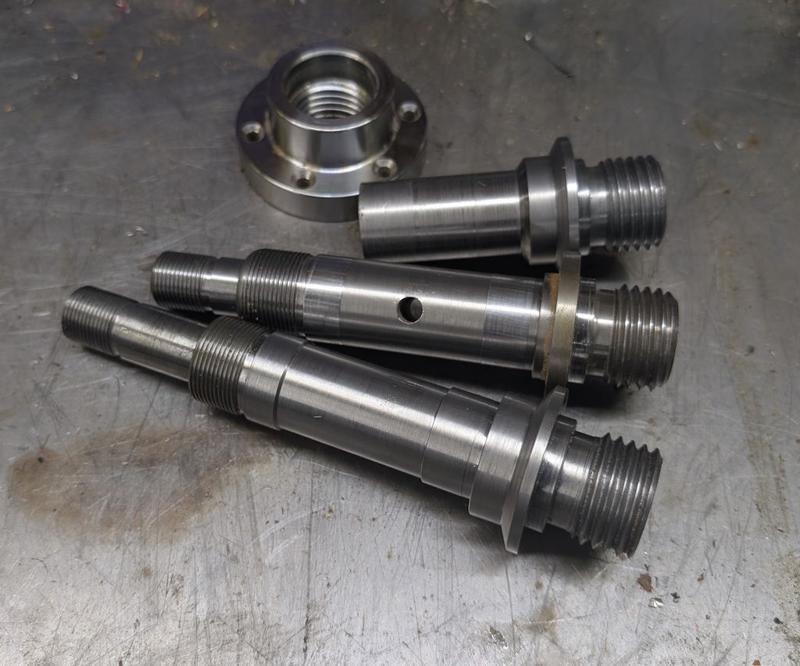
Once again, that was repeated on the off-cut, resulting in these two pieces, shown alongside the old spindle for scale:

2025-12-21-11-three-bits_800.jpg


With the roughing out done, the next job will be to turn all the remaining features. A few of them (34 mm chuck register and the 30 mm bearing seats) have quite critical dimensions, so it's important that the part isn't too hot when turning them (otherwise it'll shrink as it cools and could end up under-size). They were very hot after roughing out (hot enough that I needed to wear gloves to remove them from the lathe), so I'll leave them overnight to cool down before moving onto the next stage.
 
In between a few errands I had to run today, I've made a bit more progress with the spindle. If you're not interested in lots of very similar pictures of a spindle mounted on a metalworking lathe, look away now!

I started by moving the top slide round to be 30° from the cross-slide and then using a pointy tool to shape the rear of the ASR flange:

2025-12-22-01-shaping-asr-flange_800.jpg


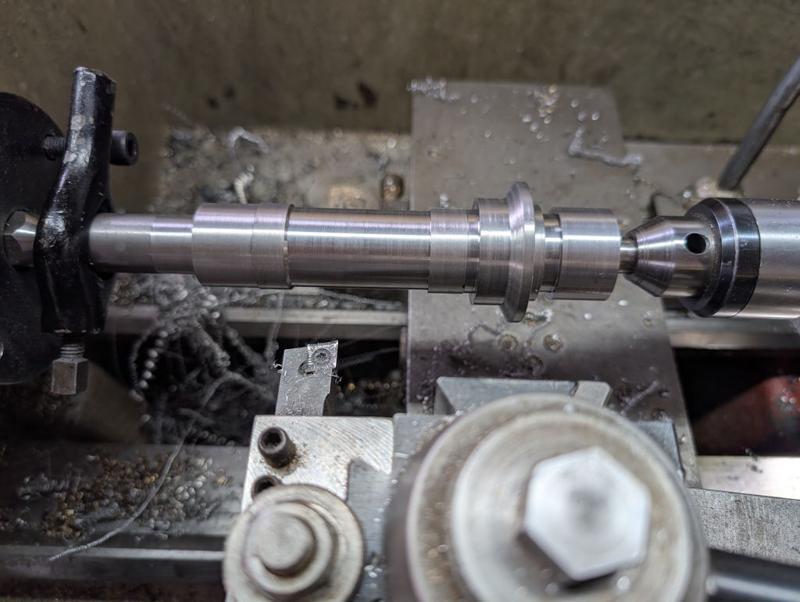
I then used that pointy tool along with a left-hand conventional tool to refine the other details, bringing everything to size except the bearing surfaces and the chuck register:

2025-12-22-02-refining-other-details_800.jpg


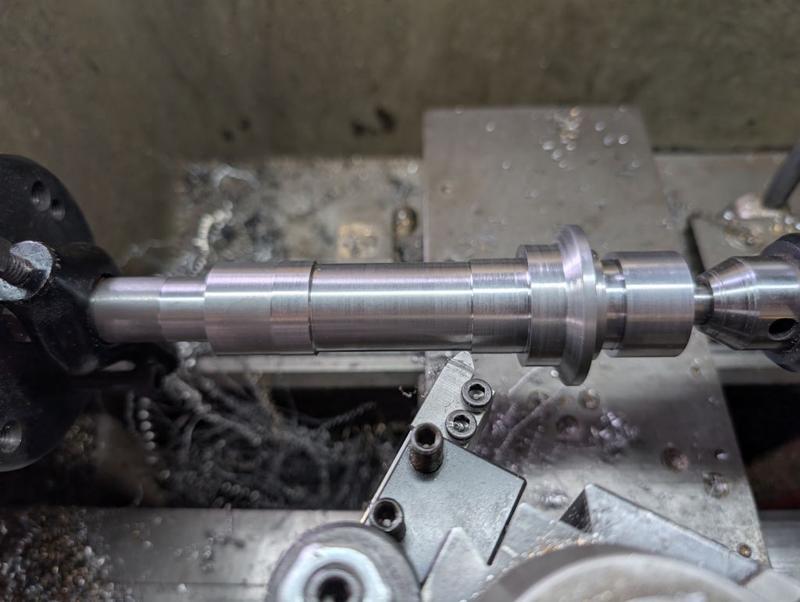
A high-speed steel tool with a rounded nose was used to bring the bearing surfaces down to size, taking lots and lots of very light passes (with the top-slide set at a little under 6° to give a 10:1 in-feed ratio). I used a micrometer after each and every pass to check the diameter as I crept up on the target (30.002 to 30.011 mm)

2025-12-22-03-rounded-nose-tool-for-bearing-surfaces_800.jpg


I did a similar thing for the chuck register but using a more pointy tool due to the need to go up to the flange. The tolerance on that was a bit looser (29.975 to 30.000 mm) so I didn't have to be quite so cautious with that one!

With the critical surfaces done, I could get on with cutting the chuck thread:

2025-12-22-04-cutting-thread_800.jpg


On the original spindle, I checked the thread using measuring wires. I now have a couple of chucks and an M33×3.5 mm face-plate, so this time I just used those to check the fit.

Once the spindle nose was complete, I did a similar job on the short adaptor thing, again turning the 30 mm bit that'll go in the collet in the same setting as the chuck register:

2025-12-22-05-shorter-version_800.jpg


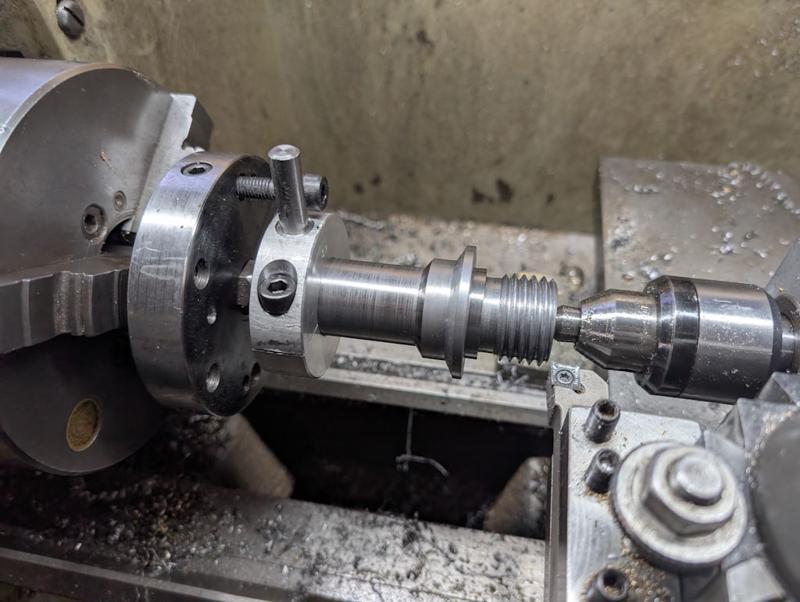
When I made the original spindle, I held the nose in the soft jaws in order to work on the threads at the rear of the spindle. This time, I fitted a face-plate to the newly-cut nose thread and put an M5 screw through one of the face-plate holes to act as a driving dog and with that done I could hold it between centres:

2025-12-22-06-using-face-plate-as-drive-dog_800.jpg


The tail threads, being 1.5 mm pitch, were quite quick and easy to cut:

2025-12-22-07-cutting-tail-threads_800.jpg


That was all the between centres turning done, but before removing the centre from the chuck, I fitted an MT2 centre between centres and used it to adjust the angle of the top-slide:

2025-12-22-08-adjusting-top-slide_800.jpg


Another view:

2025-12-22-09-adjusting-top-slide-another-view_800.jpg


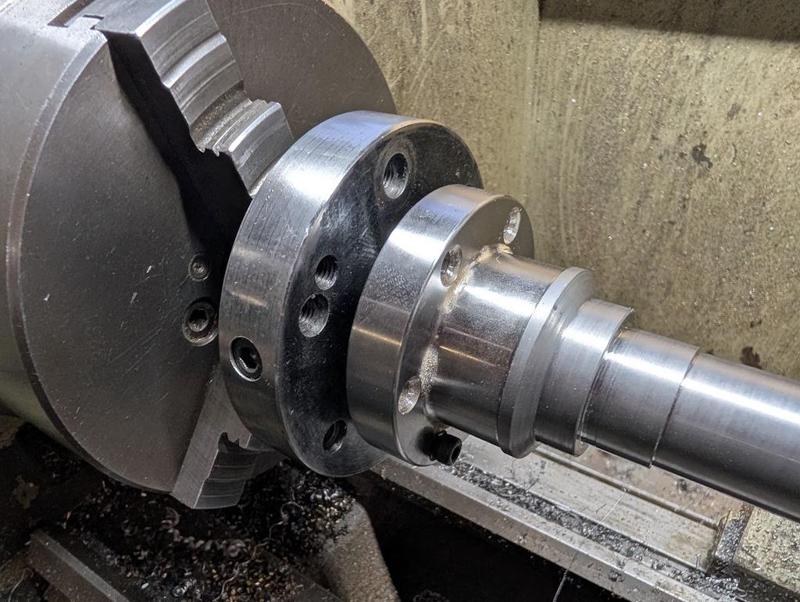
The top-slide will stay in that setting until I come to cut the Morse taper socket in the nose of the spindle, but before I do that, I need to drill all the way through. I started by mounting the face-plate in the chuck, supporting the tail end with a centre and setting up the fixed steady to support the part on the pulley surface:

2025-12-22-10-setting-up-for-drilling_800.jpg


I then drilled as deep as I could with a 10 mm drill bit and then as deep as I could with a 13 mm drill bit:

2025-12-22-11-drilled-13mm_800.jpg


That should have taken me a bit over half way. When I did the previous spindle, I bored it out to 14.6 mm (the small diameter size of a Morse Taper 2). I don't think this is necessary as I imagine the number of times I want to put a part through the spindle that's more than 13 mm but less than 14.6 mm won't be very high. This bore size is big enough for the 12.7 mm (1/2") bar I use to eject Morse tooling from the spindle so it should be fine (and the spindle will be stronger for having a slightly smaller bore).

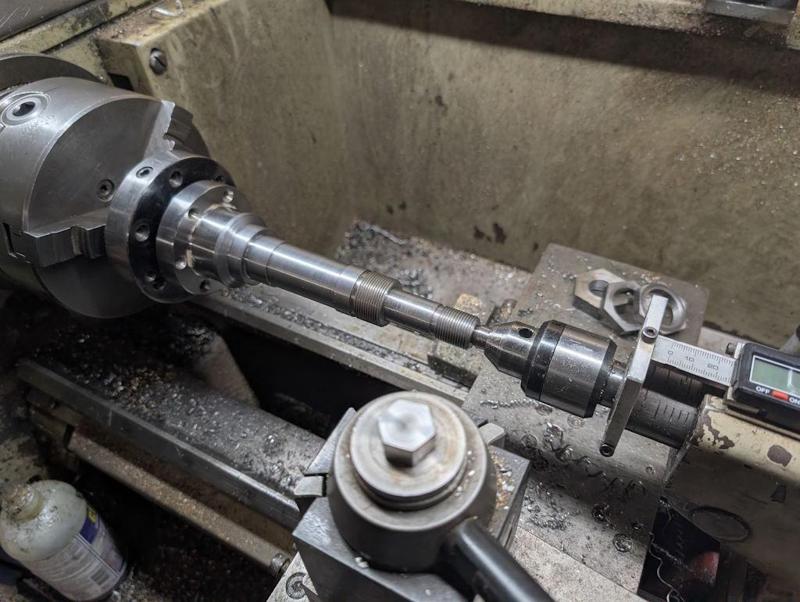
My back was starting to ache at this point (the perils of being tall) so I decided to call it a day at that point. This is where I've got to so far (note the light dusting of surface rust on the old spindle - the disadvantage of mild steel):

2025-12-22-12-so-far_800.jpg


All being well, tomorrow I'll drill through from the nose end to meet the previous hole and then I'll bore the Morse taper. The final job will (I think) be to mount the spindle in the milling machine in order to sort out the cross-drilled hole.
 
Fiddlesticks. I've made a mistake on the spindle and am feeling very annoyed at myself.

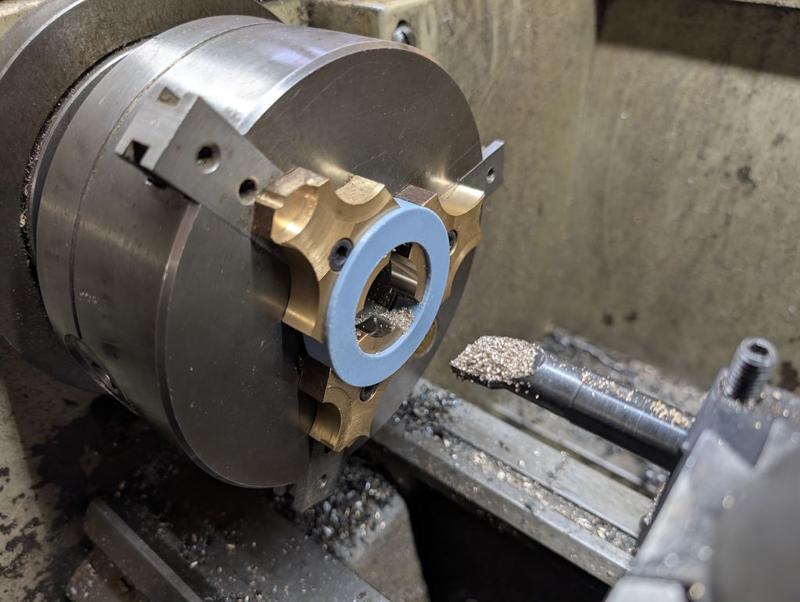
This morning, I started by mounting the soft jaws in the chuck, clamping them down on a 3D-printed helper and boring out the centre to 30 mm:

2025-12-23-01-boring-soft-jaws_800.jpg


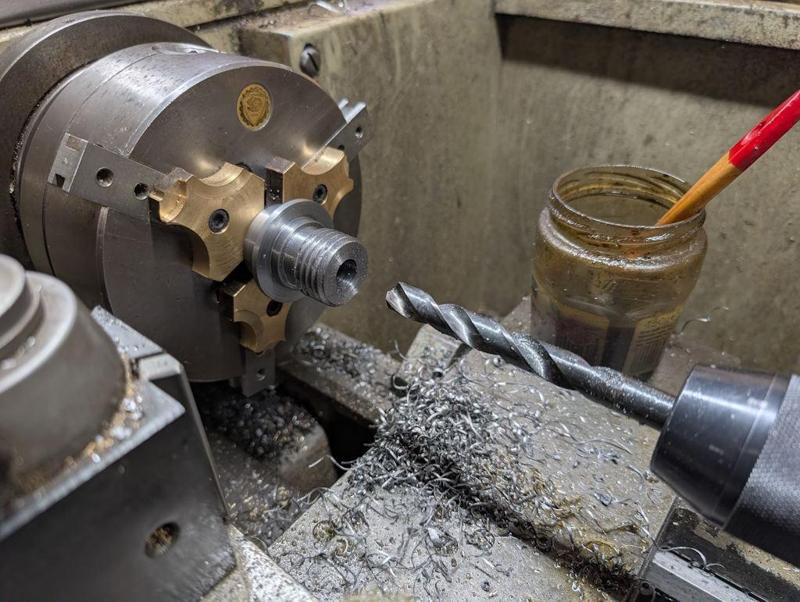
I could then mount the spindle in the soft jaws with the jaws (which should be very accurately concentric with the lathe axis having been bored in place) holding the bearing surface nearest the nose. I drilled 10 mm then 13 mm deep enough to meet the hole from the back:

2025-12-23-02-drilling_800.jpg


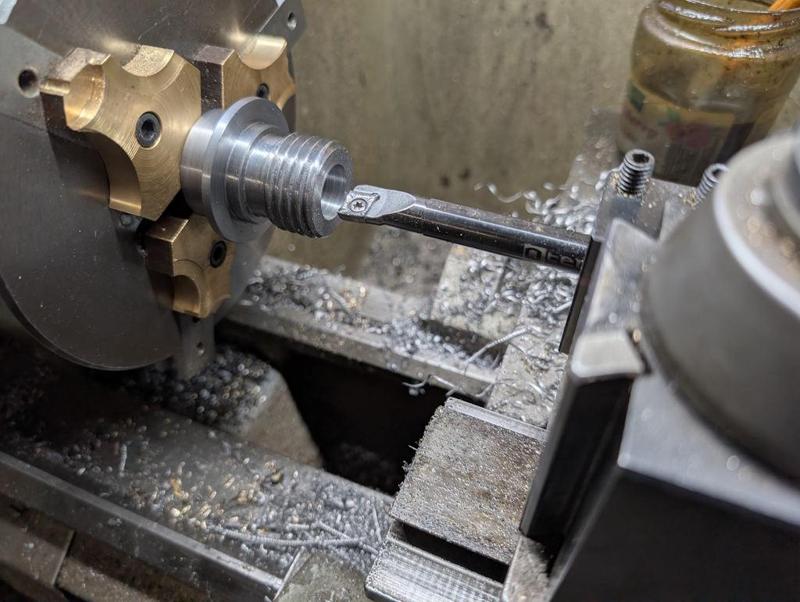
I then fitted a boring bar in the tool post and used the (previously set to the correct angle) top slide to bore the taper socket:

2025-12-23-03-boring-taper_800.jpg


Finally, I did a couple of gentle turns with the Morse taper reamer to clean up any machining marks:

2025-12-23-04-reaming-taper_800.jpg


It was then that I realised that I'd made the taper too big. I'd been checking the diameter quite often near the end of the operation but the tool had started making a slightly rough noise so I changed the tip for the last pass. I think the old tip had been more badly damaged than I'd realised and that last pass with the new tip took quite a heavy cut. It's also possible that I mis-measured on the previous passes (it's quite hard to measure the outer end diameter of a taper socket), which could have exacerbated the issue.

Anyway, when I came to do a trial fit with a drive centre, it went all the way in and was loose in the spindle:

2025-12-23-05-loose_800.jpg


The only thing I could think of doing was to bore the spindle out a bit bigger so that the face is now sub-flush:

2025-12-23-06-counter-bore_800.jpg


That's okay for all the things I've ever put in the spindle bore to date:

2025-12-23-07-now-fits_800.jpg


However, I'm not happy with it as it could be a bit limiting and will also always remind me of my mistake!

I'm going to finish off the spindle (as the only remaining operation is to cross-drill the hole for the tommy bar), but I've also ordered another (£20) length of 50 mm steel and in due course I'll start from scratch. I doubt that steel will arrive between now and when I go back to work in January, so I'll get on with some of the other jobs in the meantime and, if I get everything else done before the new bar stock arrives, I'll install this spindle and use it to test everything else is okay.
 
Al, the guy who never made a mistake, never made anything.

I/We have all been there; my wife and family used to say I could verbally strip the paint from the walls when the C.U. fairy visited me. 😳.
 
I think you've made the right decision there. You got your earlier measurements on target, within your self-imposed tight margins, so you deserve the pleasure of getting this job done right, not just nearly right.
 
Back
Top