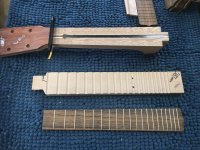
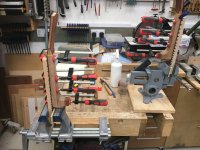
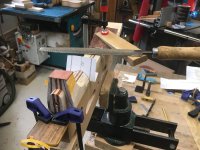
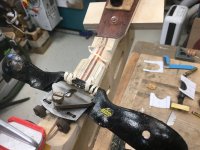
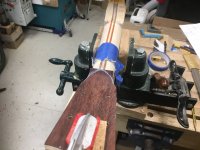
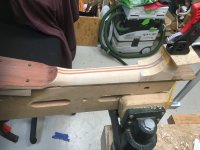
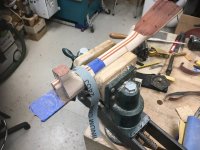
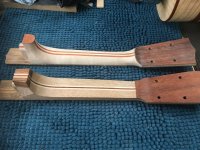
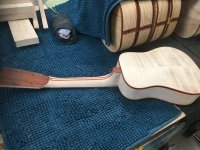
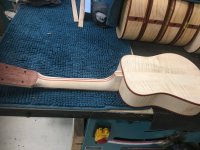
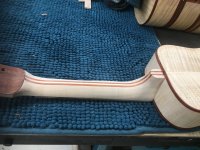
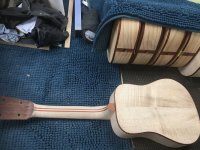
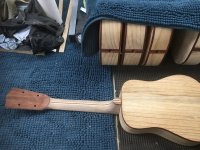
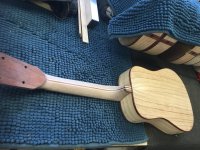
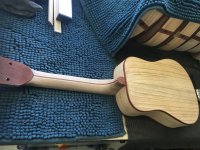
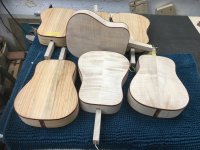
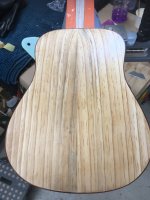
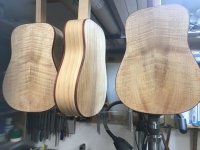
So now all the necks have been carved and fitted to their bodies, it's not quite time to fit the bridges, that's one of the last jobs after spraying, curing and finishing, but it is time to fine tune the bridge locations. My work doesn't always end up as accurate as I'd like, but it's not the end of the world. The neck lateral angle might be out by less than a degree, but that will alter the way the outer stings will locate relative to the edge of the fingerboard, but adjustments can be made at this stage to mitigate that.
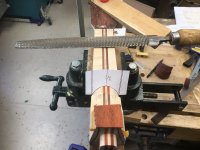
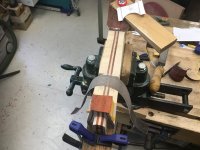
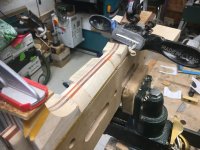
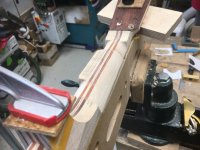
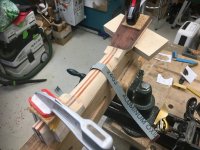
Firstly, bolt the neck in position and place two straight edges alongside.
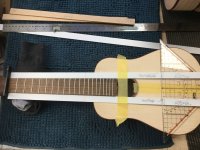
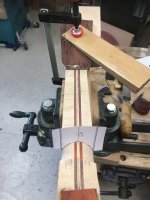
Then with the symmetrical set square I can tell that it is out of line; one edge shows 25mm and the other 22mm from the centre line.
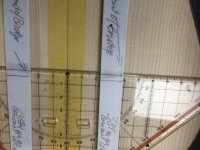
So the centre line, for the bridge, has to move.
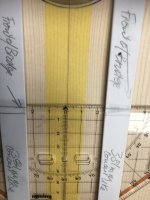
23.5mm either side offsets the centre line about a millimetre.
For my acoustic guitars and ukulele, I set the exact scale length at the second string and the saddle is angled to compensate for the thickness of the other strings. On the straight edges I mark both the scale length and the front of bridge to help me locate the bridge.
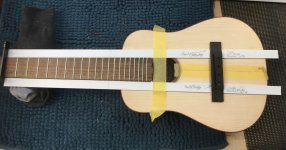
I can then use the straight edges to estimate where the outer strings will appear over the fretboard.
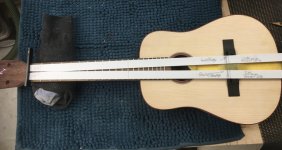
Not as good as I'd like. If the CNC machine were available this minute (it's in the rafters) I would slightly reduce the gapping od the string holes in the bridge and run off another set of bridges. It's strange, because I've followed all the plans and the outer strings are still a tad close to the edges of the fingerboard at the body end.
Anyway, locating the bridge in light of that. If you've followed my guitar builds, you will have seen the hack of drilling two little holes along the saddle groove and placing the bridge according to the last few photos, indent the soundboard with the tips of cocktail sticks and then drilling two little holes in the soundboard.
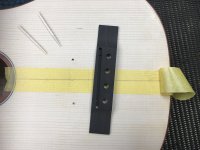
Then using the sticks to locate the bridge. Believe me, it doesn't move.
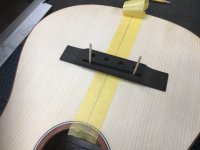
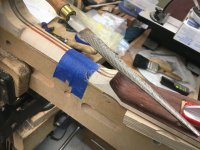
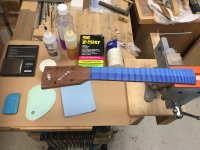
Now, the bridge has to shape masking medium so that sanding sealer and subsequent cellulose lacquer does not cover the gluing area of the bridge. I use parcel tape for this masking.
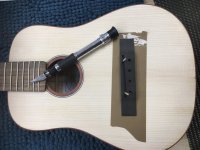
Cor, I have to use magnifying lenses and a steady hand to do this.
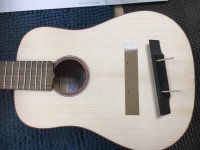
And then do the same for the fretboard overhang.
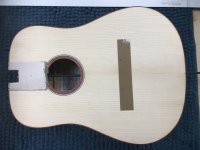
That's one done; six more to go.