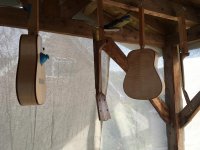
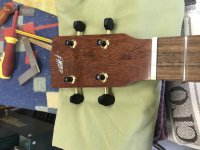
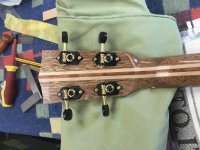
The necks have received two coats of finishing resin for pore filling and I've spent an enjoyable couple of days flattening back with my favourite scrapers, heavy duty Stanley blades.
I find sanding and scraping therapeutic and cutting/sanding back resin, so long as it's done gently, I find easy, because if the scrapings/dust are white/translucent, then they're still resin. When they change to wood colour, I can stop.
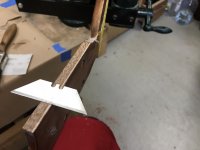
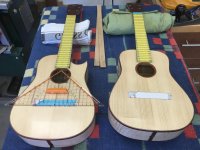
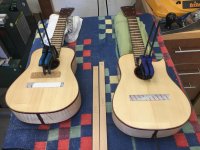
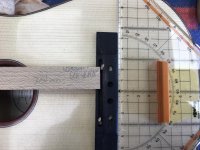
So, with the necks nearly finished, it's time to position the bridges on the bodies. For those who are new to stringed instrument construction, the scale length, the distance from the nut, (the white thing at the end of the neck), and the saddle, (the white thing on the bridge) (the black thing on the body), is critical. For these models the Scale length is 381mm. I've marked a couple of beech straight edges and cut them to scale length.
I used one to establish the saddle position.

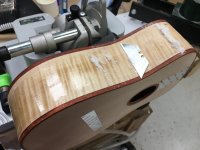
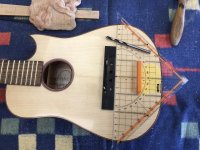
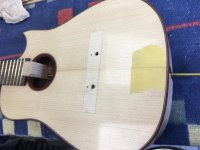
Before I go any further I need to be able to mask the area where the bridge will be located, so that the nitrocellulose spray will not cover the bridge gluing area. I used some leftover Celotex tape to cover a wider area.
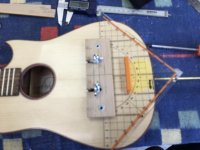
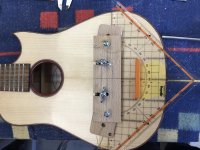
I then have to locate the bridge based on the the saddle position. The centre of the saddle is 3.5mm back from the front of the bridge, so I mark either side of the body using that special set square.

I drill two 2mm holes in the saddle slot for cocktail sticks to pass through, locate the front of the bridge against the set square and poke the sticks through their holes to mark the tape.
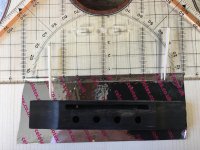
I then drill two 1.5mm holes through the body at those marks.

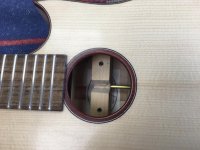
I can then poke the cocktail sticks through the holes in the saddle slot and then into the thinner holes in the body, exactly locating the bridge and and rechecking with the set square against the marks on the side of the body.
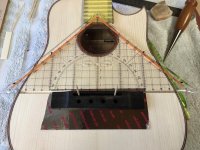
Now I can use scalpel blade with only just the weight of its handle to cut through the tape round the outside of the bridge.
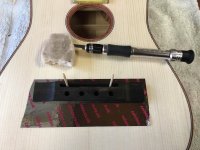
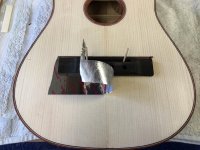
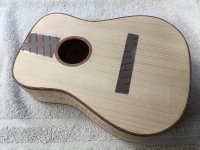
So now, the bridge is accurately located, its gluing area is masked, and I can go on to do the same to the fretboard overhang and rinse and repeat on the other instrument.
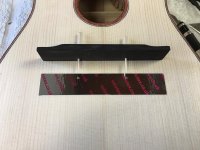
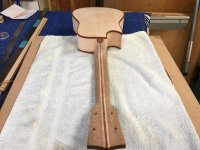
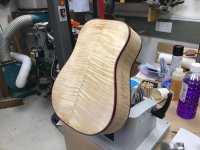
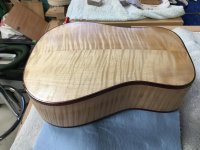
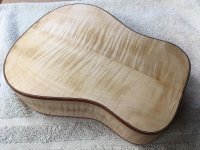
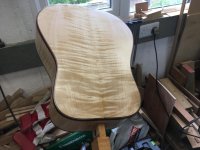
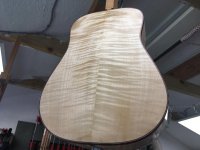
After that It will be time to pore fill the instrument bodies.
The gluing of the bridge is one of the last elements of the construction.

















 bscene-drinkingcheers: